
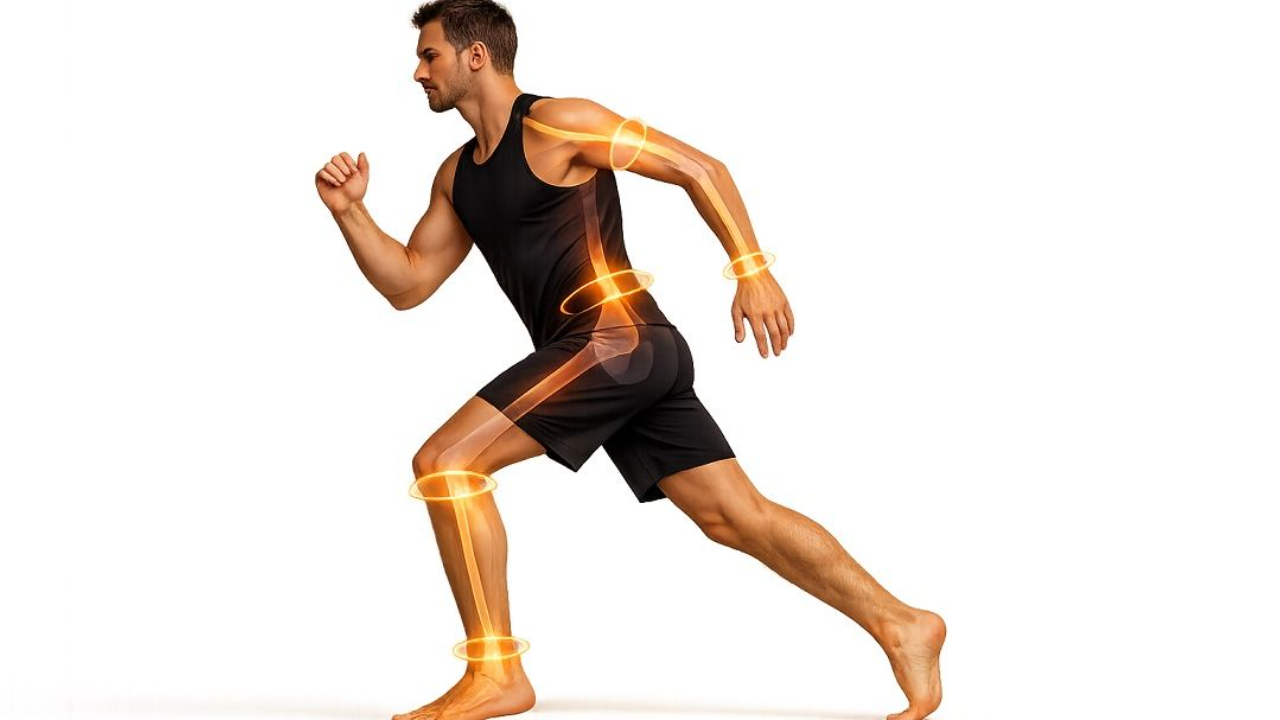
How Kinetic Chains Improve Movement Efficiency
Feb 17, 2026Kinetic chains explain how your body moves as a connected system, transferring energy from larger muscles to smaller ones for efficient motion. They play a key role in sports, daily activities, and injury prevention. When one part of the chain is weak or stiff, it forces other areas to compensate, increasing stress and injury risk.
Key takeaways:
- Energy transfer: Movement starts with larger muscles (core, legs) and flows to smaller ones (arms, hands).
- Core stability: A strong core is essential for precise and powerful limb movements.
- Injury prevention: Balanced kinetic chains reduce strain on specific joints and muscles.
- Exercise types: Closed kinetic chain exercises (like squats or push-ups) typically involve multiple joints and greater whole-body stability demands, whereas open kinetic chain exercises (like knee extensions or biceps curls) tend to emphasize more isolated joint movement. Both can be useful depending on the goal.
Whether you're an athlete or just want better movement, understanding and training your kinetic chains can improve performance and reduce injuries.
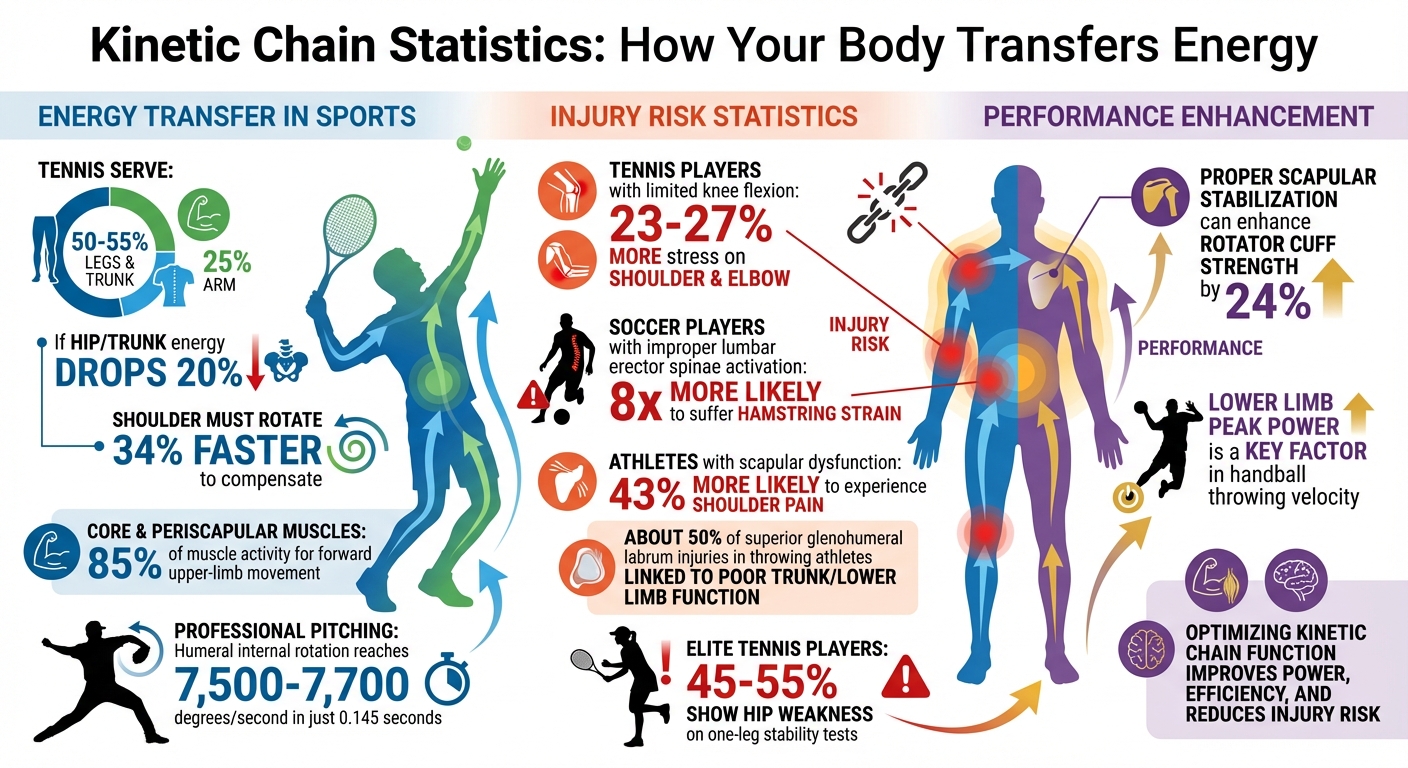
Kinetic Chain Statistics: Energy Transfer and Injury Prevention in Sports Performance
How Kinetic Chains Improve Movement Efficiency
Energy Transfer Through Sequential Activation
In movement, power is generated through a proximal-to-distal sequence. This means larger, stronger muscles in the legs and core generate energy first, which is then transferred outward to the smaller, faster muscles in the arms or feet. This process, often called velocity summation, allows multiple body segments to work together to achieve speeds far greater than any single joint could produce alone. The transfer of energy relies on the stretch-shortening cycle, a tension arc that stores and releases energy efficiently, ensuring even smaller muscles play a role. For example, studies on elite handball players show that the peak power generated by their lower limbs is a key factor in determining throwing velocity. However, this smooth energy flow hinges on one critical element: a stable core.
@instituteofhumananatomy Proximal vs Distal #IOHACourse #AnatomyClass #BiologyClass #LearnSomethingNew ♬ original sound - IOHA
Proximal Stability Enables Distal Mobility
The core acts as the central anchor of the kinetic chain, offering the stability needed for effective and powerful movements. A strong core functions like a "stabilizing corset", enabling the limbs to move with both precision and force. Without this stability, the energy transfer from one segment to another becomes inefficient. A large proportion of the muscle activity needed for rapid forward arm movements comes from the core and periscapular muscles, which provide a stable base for the limb. This explains why a weak core can disrupt the entire chain of force transfer. Haifa Saleh Almansoof from Imam Abdulrahman Bin Faisal University emphasizes this idea:
"Core proximal activation provides the precision and stability for the whip-cracking-like upper extremity distal segment maximal force."
In simpler terms, a stable core is what allows for accurate and powerful movements at the extremities.
Reducing Joint Load and Injury Risk
When the kinetic chain operates efficiently, it distributes the workload evenly across multiple joints and muscles, reducing strain on individual components and lowering the risk of injury. A balanced chain ensures that no single part is overburdened. For instance, tennis players with limited knee flexion during their serve experience 23% to 27% more stress on their shoulder and elbow. A substantial proportion of superior labrum injuries in throwing athletes are associated with deficits in trunk and lower-limb function, which alter energy transfer and increase shoulder stress. Altered activation patterns between the trunk and hamstrings, along with strength and flexibility imbalances, are linked to a higher risk of hamstring strain in soccer players.. By optimizing each link in the kinetic chain, athletes not only improve performance but also build resilience against injuries.
The Kinetic Chain and Summation of Speed EXPLAINED!
Identifying and Fixing Kinetic Chain Dysfunctions
Efficient movement relies heavily on a well-functioning kinetic chain. When disruptions occur, they can lead to inefficient energy transfer and even injuries. Identifying and addressing these dysfunctions is key to restoring balance and performance.
Common Causes of Kinetic Chain Dysfunction
Kinetic chain issues often stem from muscle imbalances that lead to predictable patterns of dysfunction. Characteristic postural patterns (such as forward head/rounded shoulders or anterior pelvic tilt) often reflect muscle imbalances and altered neuromuscular control. These imbalances can force certain muscles to overcompensate, reducing movement efficiency and potentially increasing the risk of injury during repetitive or high-demand activities. For more on how reflexes in the muscles help maintain efficient, coordinated movement and prevent injury, check out our article on Neuromuscular Reflexes in Fitness Training.
Assessment Methods for Movement Efficiency
Pinpointing dysfunctions requires a systematic evaluation of the body’s five kinetic chain checkpoints: feet/ankles, knees, lumbo-pelvic-hip complex (LPHC), shoulders, and head/cervical spine. One widely used tool is the Overhead Squat Assessment (OHSA). This test, performed barefoot with feet shoulder-width apart, involves observing five squat repetitions from multiple angles - anterior, lateral, and posterior - to evaluate neuromuscular efficiency and core strength.
For athletes, specific assessments can provide deeper insights. For instance, limited prone hip internal rotation has been linked to shoulder injuries and poor throwing mechanics in overhead sports. Studies in elite tennis players report that a large proportion show hip weakness or stability deficits on single-leg tests, even when uninjured, highlighting the need to assess and train hip function.. The Bunkie Test is an emerging tool that challenges core endurance and examines patterns along proposed fascial lines. Early research suggests it may help identify kinetic-chain and fascial dysfunctions, but more validation studies are needed. As Master Instructor Geoff Lecovin puts it:
"If you are not assessing, you are just guessing!"
Identifying these dysfunctions is only the first step - targeted exercises are necessary to restore balance and efficiency.
Corrective Exercises for Dysfunction
Addressing dysfunctions should follow a proximal-to-distal approach, focusing first on core and lower-extremity strength before moving to more distal areas. For Lower Cross Syndrome, the approach involves stretching tight muscles like the hip flexors, erector spinae, and calves while strengthening weaker muscles such as the glutes and abdominals. For Upper Cross Syndrome, stretching tight pectorals and upper trapezius muscles, combined with strengthening the mid-trapezius, serratus anterior, and deep neck flexors, can help restore alignment.
Closed kinetic chain exercises - where the distal segment remains fixed, such as in push-ups or squats - play a crucial role in early rehabilitation. These exercises promote joint stability, encourage co-contraction of muscles, and reduce shear forces. For example, the "Low Row" exercise activates the lower trapezius and serratus anterior while limiting overactivity in the upper trapezius. To address posterior shoulder tightness, stretches like the "Sleeper Stretch" and "Cross-body Stretch" target Glenohumeral Internal Rotation Deficit. Research even suggests that proper scapular stabilization can enhance rotator cuff strength by as much as 24%. Aaron Sciascia from the Shoulder Center of Kentucky explains:
"The retracted scapula then can act as a stable base for the origin of all the rotator cuff muscles so they can activate optimally."
Sport-Specific Applications of Kinetic Chains
Kinetic chains aren't just a theoretical concept - they play a critical role in how athletes perform across various sports. By understanding how energy flows through the body in specific activities, athletes can fine-tune their movements, boost performance, and lower the risk of injuries. Each sport has its own unique demands when it comes to energy transfer and muscle coordination.
Linear Power Sports
Sports like sprinting and swimming rely heavily on a movement sequence called proximal-to-distal sequencing. This means energy starts in the larger muscles of the core and hips, then flows outward to smaller segments. For example, in freestyle swimming, the power generated by the lower limbs is closely linked to faster sprint-swim speeds. The lower kinetic chain - comprising the toes, feet, ankles, legs, hips, and pelvis - plays a key role in driving forward motion and keeping the core stable.
A perfect example of this is the "triple extension", where the ankle, knee, and hip extend together. This is vital for explosive moves like sprint starts or swim block takeoffs. Because these are closed-chain movements (where the foot remains in contact with a surface), any weakness or limited mobility in one joint can disrupt the entire motion and reduce overall performance.
Rotational and Throwing Sports
Sports such as baseball, golf, and tennis depend on a smooth, sequential transfer of energy starting from the ground and moving upward. Take a tennis serve, for instance - about 50% to 55% of the energy needed comes from the legs and trunk. If energy from the hips and trunk drops by even 20%, the shoulder has to work 34% harder to maintain the same force at the hand.
Shane T. Seroyer, MD, from Rush University, breaks it down:
"The overhead throwing motion is a coordinated effort of muscle units from the entire body, culminating with explosive motion of the upper extremity."
In professional pitching, the speed of humeral internal rotation can hit an astonishing 7,500–7,700 degrees per second, all within just 0.145 seconds. However, when tennis players fail to properly flex their knees during the serve backswing, the stress on their shoulders and elbows increases significantly - by 23% to 27%. This highlights how poor coordination in the larger, proximal muscles forces smaller, distal joints to pick up the slack, which can lead to injuries. These sports emphasize how critical it is to maintain a well-coordinated kinetic chain, especially during explosive upper-body movements.
Repetitive Movement Sports
Unlike sports that rely on quick bursts of power, repetitive movement sports - such as cycling, rowing, and swimming - require sustained chain efficiency to avoid overuse injuries. Repeated motions can cause the fascia (the connective tissue around muscles) to thicken and tighten, which may disrupt the kinetic chain's effectiveness. For example, core and periscapular muscles are responsible for nearly 85% of the effort needed to control a forward-moving upper limb. This underscores the importance of core stability in endurance sports.
Haifa Saleh Almansoof, from the Department of Physical Therapy at Imam Abdulrahman Bin Faisal University, explains:
"Any blockage or defect in the kinetic chain can develop compensatory patterns, high demands on distal parts, and overuse and overload injuries."
To address these challenges, athletes in repetitive sports often use tools like the Bunkie test to identify restrictions in myofascial lines, which can prevent harmful compensatory patterns. Closed kinetic chain exercises that encourage co-contraction and improve proprioception are also essential for maintaining joint stability during the high training volumes typical of these sports.
Adding Kinetic Chain Training to Your Fitness Program
Training the Body as a Connected System
When we think about how the body moves, it’s clear that everything works together as a unit. Yet, traditional workouts often focus on isolating individual muscles. Kinetic chain training flips that approach by emphasizing exercises that engage multiple muscle groups working in harmony. Take the front squat to overhead press, for instance - this movement connects the legs, core, and arms, allowing energy to flow efficiently through the body. The result? Improved coordination and smoother, more effective movements.
Superhuman Strength: Secrets of Muscle Variation
Targeting Root Causes of Dysfunction
One of the standout features of kinetic chain training is its ability to identify and address hidden movement issues. For example, low back pain might not stem from the back itself but could be linked to stiffness or restrictions in nearby joints. Aaron Sciascia from the Shoulder Center of Kentucky highlights this interconnected perspective:
"Rehabilitation of shoulder injuries should involve evaluation for and restoration of all kinetic chain deficits that may hinder kinetic chain function."
To tackle these challenges, a step-by-step approach works best. Start with mobility exercises targeting key areas like the hamstrings, hip flexors, and posterior shoulders. Next, focus on building stability in the core and scapular muscles. Finally, move on to more advanced exercises like closed-chain and rotational movements. This progression not only improves performance but also reduces the risk of injury.
Benefits for Recovery and Performance
Strengthening the kinetic chains isn’t just about avoiding injuries - it also boosts overall performance. For instance, improving scapular stability can enhance how force is transferred throughout the body.
A balanced training program should include both closed-chain exercises, like squats and push-ups, to build joint stability, and open-chain exercises, like leg extensions and bicep curls, to target specific weaknesses and expand your range of motion. By customizing your workout to your specific goals, you can fine-tune coordination and address any imbalances holding you back.
Conclusion
Why Kinetic Chains Matter
Understanding how energy flows through your body can completely change the way you train. When your kinetic chains work smoothly, your larger, central muscles - like your legs and core - generate power that transfers effectively to smaller, more distant parts, like your hands or feet. This efficiency not only boosts performance but also reduces the risk of injury. Take a tennis serve, for example: about 54% of the power comes from your legs and trunk, while only 25% comes from your arm. If one part of this chain falters, the impact can be dramatic. A 20% drop in energy from your hips and trunk means your shoulder has to rotate 34% faster to compensate. That’s not just inefficient - it’s a fast track to injury.
Pain in one area of your body often originates from dysfunction elsewhere. A stiff hip can lead to back pain, weak glutes might result in knee issues, and athletes with scapular dysfunction are 43% more likely to experience shoulder pain. Addressing the root cause rather than just treating symptoms is key to improving performance and preventing injuries.
Armed with this understanding, you can now start making meaningful changes to your training.
Next Steps for Implementation
You don’t need to completely overhaul your routine to get started with kinetic chain training. Begin by analyzing your movement patterns and identifying weak links. Tools like the Y-Balance Test for lower body control or the Closed Kinetic Chain Upper Extremity Stability Test can help pinpoint hidden dysfunctions before they lead to injuries.
Next, focus on your core - the central hub for all movement. A strong core ensures smooth energy transfer between your upper and lower body. The lumbopelvic-hip complex, in particular, plays a crucial role in this process. Incorporate both closed-chain exercises for stability and open-chain movements to address specific weaknesses. But don’t rush - your nervous system needs time to adapt to these new, efficient movement patterns.
It’s also worth noting that your periscapular and core muscles contribute roughly 85% of the activation required to control forward-moving limbs. By strengthening these areas, you’ll not only improve your power but also make your movements more efficient and resilient.
For more detailed anatomical knowledge and practical training tips, check out the resources offered by the Institute of Human Anatomy. Their courses and guides can help you dive deeper into kinetic chain training and refine your approach to movement efficiency.
FAQs
How can I tell if my movement patterns are affected by a kinetic chain dysfunction?
Kinetic chain issues often show up as irregular movement patterns or muscle imbalances. For example, you might see tight or overactive muscles like the hamstrings or hip flexors working overtime, while weak or underactive muscles such as the glutes or core fail to pull their weight. These imbalances can cause compensatory movements, putting extra strain on other parts of the body.
Feeling stiff, noticing a limited range of motion, or experiencing discomfort during activities could be a sign of kinetic chain dysfunction. A professional assessment can identify these imbalances and recommend corrective exercises to help restore smooth and efficient movement.
What are the best core exercises to improve movement efficiency through the kinetic chain?
Strengthening your core is the foundation for improving movement efficiency through the kinetic chain. To achieve this, focus on a combination of closed-chain exercises and functional movements. Closed-chain exercises - like push-ups or resistance band walkouts - are excellent because they engage multiple muscle groups while building stability. Meanwhile, functional movements such as squats, lunges, and rotational exercises train your body to work as a cohesive unit.
A well-rounded routine should target both the deep stabilizing muscles (like the pelvic floor and multifidus) and the outer muscles that handle strength and power transfer. For instance, exercises like front squats combined with overhead presses or push-ups paired with sliding pike movements are particularly effective. These not only improve neural coordination but also optimize how your body transfers force, leading to better overall movement efficiency.
If you're curious to dive deeper into human anatomy and how it relates to movement, the Institute of Human Anatomy provides excellent resources to help you understand the mechanics behind effective training.
How does improving the function of kinetic chains help prevent injuries?
Improving the function of kinetic chains is all about ensuring your body moves as a well-coordinated system. When muscles and joints in the chain work seamlessly together, the forces generated during movement are spread out evenly. This reduces strain on specific areas, lowering the chances of issues like joint pain or muscle strains caused by overuse or poor mechanics.
However, when certain areas are weak or overly tight - think stiff hip flexors or inactive glutes - it throws off this balance. The result? Other parts of the body take on extra stress, which can lead to injuries. By pinpointing and addressing these weak spots with targeted exercises, you can improve how your body moves, reduce abnormal stress, and build a stronger, more resilient system. Keeping your kinetic chains strong and functional is essential for avoiding injuries and performing at your best.

