
Neuromuscular Reflexes in Fitness Training
Jan 25, 2026Neuromuscular reflexes are quick, automatic responses that protect your body and improve movement efficiency. These reflexes operate through a spinal cord pathway, bypassing the brain to enable rapid muscle reactions within milliseconds. In fitness, they play a critical role in stabilizing joints, maintaining balance, and enhancing athletic performance. Key mechanisms include the stretch reflex, muscle spindles, and reflex arcs, which ensure smooth, coordinated movements during activities like jumping, sprinting, or lifting. Training these reflexes through plyometrics, balance exercises, and reaction drills can improve power, reduce injury risk, and optimize movement patterns. Regular practice is essential to maintain these benefits over time.
Neuromuscular Efficiency Defined - Low vs. High Explained
The Anatomy Behind Neuromuscular Reflexes
Understanding the intricate details of reflex anatomy provides valuable insight into how these mechanisms enhance movement and support fitness training.
Key Components of Reflex Arcs
A reflex arc is the neural pathway responsible for quick, automatic responses. It consists of five essential parts working together: a receptor, like a muscle spindle, that detects stimuli; a sensory neuron that transmits the signal to the central nervous system; an integration center - usually in the spinal cord or brainstem - that processes the information; a motor neuron that delivers the command; and an effector, such as a muscle, that carries out the response. Understanding these pathways is one of the essential anatomical principles trainers use to optimize motor unit recruitment and ensure client safety.
Monosynaptic reflexes, like the myotatic reflex, involve just two neurons, enabling incredibly fast reactions. In fact, the myotatic reflex is the quickest in the human body. On the other hand, polysynaptic reflexes, such as the flexor withdrawal reflex that pulls your hand away from a hot object, involve interneurons. This added complexity allows for reciprocal inhibition, where antagonist muscles relax as agonist muscles contract, ensuring smooth and coordinated movement. Notably, Ia afferent fibers - among the largest and fastest peripheral nerve fibers - play a pivotal role in transmitting these signals.
"Reflexes are hard-wired and require no conscious thought." - Jim Hutchins, Author and Professor
This foundational understanding lays the groundwork for exploring how muscle spindles contribute to the stretch reflex.
Muscle Spindles and Stretch Reflexes
Muscle spindles are specialized sensory receptors located within the muscle, aligned parallel to the surrounding extrafusal fibers. These receptors, containing 6 to 8 intrafusal fibers, continuously monitor the degree and speed of muscle stretching. For example, during a rapid movement like the descent in a squat, the spindles can send a signal in as little as 22 milliseconds.
This signal triggers an immediate contraction in the stretched muscle, while simultaneously relaxing the opposing muscle through reciprocal inhibition. This built-in safety mechanism helps prevent overstretching. Additionally, alpha-gamma coactivation ensures that the spindles remain sensitive even as the muscle contracts, providing constant feedback throughout the movement.
These rapid, automatic responses are further clarified through the detailed observations provided by cadaver studies.
Insights from Cadaver-Based Studies
Cadaver-based studies offer a closer look at the physical structures that make neuromuscular reflexes possible. Dissections reveal the exact placement of muscle spindles within the muscle belly - running parallel to extrafusal fibers - and highlight features like the connective tissue sheath encasing 6 to 10 intrafusal fibers. The Institute of Human Anatomy uses human cadavers to demonstrate these complex structures.
These studies also show that some motor neuron axons can extend nearly 3.3 feet (1 meter) to reach distal muscles. Analyses of the ventral horn reveal multipolar neurons surrounded by a dense network of dendrites. Such findings illustrate how sensory signals travel from the dorsal root ganglion, through the spinal cord's lamina, to coordinate the rapid, protective reflexes that enhance movement efficiency.
How Neuromuscular Reflexes Apply to Fitness Training
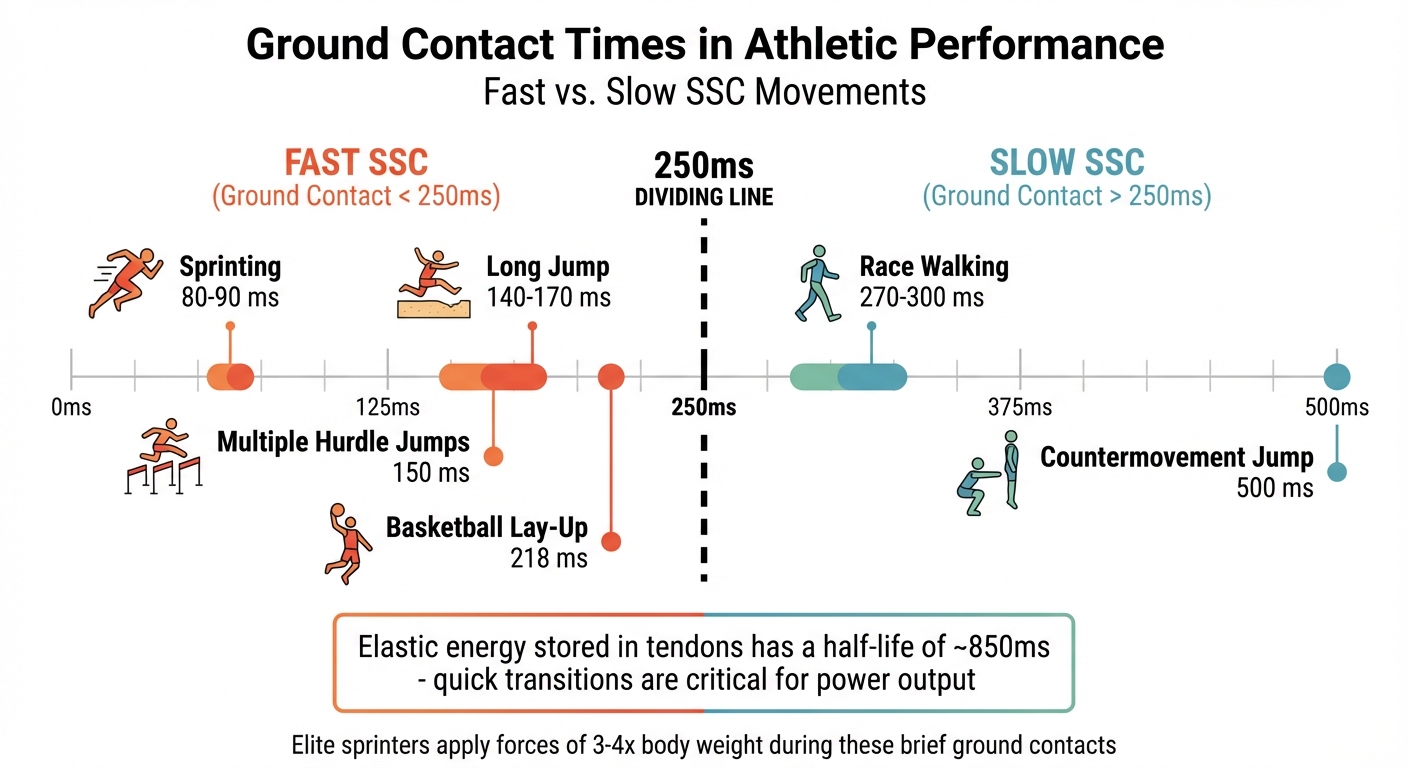
Ground Contact Times and SSC Classification for Athletic Exercises
Understanding how reflexes work is just the beginning. Applying these principles during training can elevate athletic performance by enhancing power, balance, and reaction time. Let’s break down how these reflexes are tied to specific exercises and their benefits.
Plyometrics and the Stretch-Shortening Cycle
Plyometric exercises are designed to tap into the efficiency of reflex arcs, boosting explosive power. Movements like box jumps and depth jumps rely on the Stretch-Shortening Cycle (SSC), which uses muscle spindle reflexes to increase motor unit activation and power output. For example, athletes can jump 2-4 cm higher in a countermovement jump compared to a squat jump because the countermovement utilizes the SSC.
Elite sprinters take this principle to the next level, applying forces of 3-4 times their body weight during a ground contact time of just 80-90 milliseconds. The SSC also helps recover approximately 60% of total mechanical energy during efficient sprinting.
"The SSC, otherwise known as the reverse action of muscles, is a spring-like mechanism shown to enhance athletic performance both in explosive- and endurance-based sports." - Will Saville, Science for Sport
A key factor in plyometric training is minimizing the time between the eccentric (lengthening) and concentric (shortening) phases of a movement. Fast-SSC movements, like sprinting or hurdle jumps, involve ground contact times under 250 milliseconds, while slower SSC movements, such as countermovement jumps, take longer. Training can also reduce the inhibitory effect of the Golgi Tendon Organ, which normally limits force to prevent injury. With four months of plyometric training, this mechanism can be "disinhibited", allowing athletes to produce more power.
The elastic energy stored in tendons has a half-life of around 850 milliseconds, so quick transitions are critical. Here’s a breakdown of ground contact times for various activities:
| Exercise | Ground Contact Time (ms) | SSC Classification |
|---|---|---|
| Sprinting | 80-90 | Fast |
| Long Jump | 140-170 | Fast |
| Multiple Hurdle Jumps | 150 | Fast |
| Basketball Lay-Up | 218 | Fast |
| Race Walking | 270-300 | Slow |
| Countermovement Jump | 500 | Slow |
Balance and Postural Reflex Training
Balance training sharpens the nervous system’s ability to stabilize movement through reflexes. The crossed-extensor reflex, for instance, automatically shifts weight to the opposite limb when one side is challenged, helping to prevent falls. This reflex works alongside other protective neuromuscular mechanisms.
Exercises like single-leg squats, balance board drills, and training on unstable surfaces amplify these reflexive responses. When working in unstable conditions, long-latency stretch reflexes - controlled by the motor cortex - kick in to improve limb stability. Adding visual feedback, such as mirrors or video analysis, can help athletes spot and correct issues like inward knee collapse (valgus) during landings.
"Neuromuscular training is really teaching nerves how to make the muscles work in a way that is consistent with best performance and lower injury risk." - Dr. Michele LaBotz, Sports Medicine Physician
The results of such training are impressive. In one study, adolescent squat technique improved from 29% to 71% in girls and 45% to 61% in boys when they received simple neuromuscular feedback. Additionally, programs targeting neuromuscular reflexes have been shown to reduce injuries like ACL tears and ankle sprains by up to 80%.
Reactive Strength and Speed Drills
Speed and agility drills build on these neuromuscular principles by training the body to execute fast, precise movements without overthinking. Exercises like sprints, shuttle runs, hurdle hops, and cutting drills improve muscular pre-activity, where muscles stiffen before ground contact to better transfer force into tendons.
This pre-activation helps counteract Electromechanical Delay (EMD), which is the slight lag between muscle activation and actual force production. Ballistic training prepares muscles for impact, ensuring that force is transmitted to the skeletal system more efficiently.
To get the most out of these drills, focus on movement quality. Using technical cues to refine posture during explosive movements is key. Stronger athletes, who can store more elastic energy, benefit even more when reflex training is combined with traditional strength exercises.
Adding Reflex Training to Your Workout Routine
Building on the neuromuscular reflex concepts discussed earlier, let’s explore how to weave these methods into your regular training. Reflex training isn’t a one-and-done deal - it needs to be a consistent part of your routine to keep seeing results. As Joseph Janosky, DrPH, Director of Sports Injury Prevention Programs at HSS, explains:
"It's sort of like taking your vitamins - once you stop doing it, the benefits fade. You have to keep taking them... to get results."
Here’s how you can effectively integrate reflex training into your workouts.
How to Design Reflex Training Workouts
To get started, set aside 30–45 minutes, two to three times a week, for exercises aimed at improving balance and mobility. Each session should include six to ten exercises that challenge your neuromuscular system in different ways. Adding environmental challenges can make these workouts even more effective. For example, try catching a weighted ball, using reflex balls (priced around $8.00–$20.00), or incorporating reaction training light pods, which range from $150.00 to $480.00.
Progression is key to keeping your reflexes sharp. Start on stable surfaces, then gradually introduce unstable ones like foam pads. Narrow your stance or limit visual input to further stimulate your reflexes. You can also include drills that move your joints slightly (5–15%) away from their neutral position. This activates the muscle spindles and enhances motor control. For instance, in 2022, an elite male long jumper recovering from osteitis pubis used force plate monitoring and direction bias exercises as part of his rehab. Initially, his symptomatic leg scored 83 (relative to body weight), but by week 14, it reached 170, helping him achieve a personal best jump at an international competition.
Pay attention to your form - if it starts to break down, it’s a sign the exercise might be too challenging or that you’re fatigued. Take a break when needed. Tools like video feedback or guidance from a coach can help you fine-tune your technique and strengthen the connection between your mind and body.
Combining Reflex Training with Core Stability
Reflex training becomes even more effective when paired with core stability work. Your core doesn’t operate in isolation - it works alongside your hips and legs to keep your body stable. For example, when you reach forward, your neuromuscular system activates your core and lower body to stabilize your trunk before your arm even moves. Training these anticipatory muscle actions through functional exercises can improve your stability during fast-paced activities.
A great way to combine reflex and core work is through dual-task exercises. Try holding a plank while catching a reflex ball, or balance on one leg on a foam pad while rotating your torso. These exercises mimic real-life movements and the demands of sports. Plus, consistent neuromuscular training has been shown to lower the risk of injuries like ACL tears and ankle sprains by as much as 80%.
Conclusion
Grasping the role of neuromuscular reflexes can be a game-changer for improving both training and performance. These reflexes, which activate in just 1/100th of a second, are at the heart of smooth, efficient movement. By focusing on reflex training, you enhance the communication between your nerves and muscles, helping your body respond more quickly and move with greater precision. This refined connection is the backbone of the advanced training methods outlined earlier.
Neuromuscular training not only boosts movement efficiency but also lowers the risk of injury. It trains your nervous system to engage muscles in the most effective patterns. Whether you're doing plyometric exercises, tackling balance challenges, or practicing reactive drills, you're teaching your body to stabilize joints using far less energy than voluntary muscle contractions typically require.
"Neuromuscular training is really teaching nerves how to make the muscles work in a way that is consistent with best performance and lower injury risk".
This method also focuses on fixing basic movement patterns - like ensuring proper knee alignment during landings - to help prevent injuries such as ACL tears while improving athletic performance. The key to success lies in maintaining consistency over time.
Training your reflexes also improves motor unit synchronization, increases firing rates, and optimizes movement patterns, leading to long-lasting performance improvements. These benefits work hand in hand with the physical gains from strength and endurance training, offering a well-rounded approach to fitness that supports sustainable, long-term progress.
FAQs
How do neuromuscular reflexes enhance athletic performance?
Neuromuscular reflexes are the body's quick, automatic reactions to sensory signals, enabling muscles to respond almost instantly to sudden changes like unexpected stretches or shifts in balance. These reflexes play a key role in stabilizing joints, maintaining posture, and adjusting muscle length during movement - all of which are essential for athletic performance.
When reflex sensitivity and speed improve, athletes gain the ability to land more securely, pivot more quickly, and remain steady on uneven terrain. Training techniques such as plyometrics, single-leg balance drills, and reactive agility exercises are excellent ways to sharpen these reflexes. The results? Better coordination, stronger muscle engagement, and a lower risk of injuries.
For those interested in exploring the mechanics of reflexes further, the Institute of Human Anatomy provides in-depth resources like cadaver-based videos and study guides. These tools can help athletes and coaches apply anatomical insights to boost performance on the field or court.
What are the advantages of adding reflex training to your fitness routine?
Incorporating reflex training into your workouts can sharpen your body’s ability to react quickly and efficiently during dynamic movements. It engages your neuromuscular reflexes, helping to improve reaction time, balance, and stability - key components for activities like sprinting, jumping, or making quick directional changes. Beyond enhancing athletic performance, this type of training can also lower the risk of injuries like strains or sprains.
Reflex training also strengthens muscle memory and refines body control, making your movements smoother and more automatic. If you want to take it a step further, understanding reflex arcs can make your training even more effective. The Institute of Human Anatomy provides excellent visual resources that break down how your nervous system and muscles work together, giving you the tools to apply science-backed methods for better outcomes.
How do balance exercises improve neuromuscular reflexes?
Balance exercises, like single-leg stands or grapevine steps, push your body to stay steady while your center of gravity shifts. This ongoing challenge helps train your nervous system to fine-tune reflex pathways, sharpening how quickly and accurately your muscles respond automatically.
Studies have found that regular balance training boosts proprioception - your body's sense of position - and reduces reaction times. This happens because it improves the coordination between your muscles and nerves. As a result, you can move more efficiently, enhance athletic performance, and reduce the likelihood of injuries.
If you're curious about the anatomy behind these reflexes, the Institute of Human Anatomy provides in-depth resources that explain how muscles, nerves, and joints work together during movement. Pairing balance exercises with an understanding of how your body functions can lead to better outcomes in both fitness and dynamic activities.

