
How to Study Anatomy: 5 Proven Memory Techniques
Dec 15, 2025Studying anatomy can feel overwhelming with its vast amount of information, but the right techniques can make it manageable. Here are five effective methods to help you retain and recall complex anatomical details:
- Mnemonics: Use acronyms, rhymes, or personalized associations to simplify memorization. For example:
- Cranial nerves: "Oh, Oh, Oh, To Touch And Feel Very Green Vegetables, AH!"
- Carpal bones: "Some Lovers Try Positions That They Can't Handle."
- Visual Tools: Leverage 3D anatomy apps, cadaver-based resources, and sketching to understand spatial relationships and structures.
- Active Recall: Test yourself frequently using quizzes and flashcards. Spaced repetition ensures long-term retention.
- Memory Palaces: Assign anatomical details to familiar locations (e.g., your home) and mentally "walk" through them to recall sequences or structures.
- Connect Anatomy to Physiology: Link structures to their functions to create meaningful associations and deepen your understanding.
The BEST Way to Learn ANYTHING (Especially Anatomy)!!! | Institute of Human Anatomy
1. Mnemonics: Simplifying Complex Anatomy
Mastering anatomy can feel overwhelming, but mnemonics come to the rescue by turning complicated information into bite-sized, memorable cues. These mental shortcuts rely on our brain's natural ability to remember stories, images, and patterns better than isolated facts. By linking abstract anatomy to vivid, relatable associations, mnemonics make even the trickiest topics easier to recall.
Take, for example, the 12 cranial nerves or the 8 carpal bones. Mnemonics can transform these dense lists into catchy acronyms or phrases, making them as easy to remember as the lyrics to your favorite song. Let’s dive into three ways to use mnemonics effectively.
Using Acronyms for Key Systems
Acronyms are a lifesaver when it comes to memorizing sequential lists or grouped structures. By taking the first letter of each item, you can create a memorable word or phrase that sticks in your mind.
For instance, to remember the 12 cranial nerves in order, try this classic mnemonic:
"Oh, Oh, Oh, To Touch And Feel Very Green Vegetables, AH!"
Here’s what it stands for:
- Olfactory
- Optic
- Oculomotor
- Trochlear
- Trigeminal
- Abducens
- Facial
- Vestibulocochlear
- Glossopharyngeal
- Vagus
- Accessory
- Hypoglossal
Similarly, the carpal bones become much easier to memorize with the phrase:
"Some Lovers Try Positions That They Can't Handle."
This represents:
- Scaphoid
- Lunate
- Triquetrum
- Pisiform
- Trapezium
- Trapezoid
- Capitate
- Hamate
And for the layers of the scalp, the mnemonic "SCALP" is both simple and self-explanatory:
- Skin
- Connective tissue
- Aponeurosis
- Loose connective tissue
- Pericranium
Creating Rhymes and Phrases
Rhymes and rhythmic phrases are another great way to make information stick. They work by creating natural patterns that reinforce relationships, making them particularly useful for functional or directional concepts.
For example, to remember the rule for lateral and medial rotation, you might use this phrase:
"Laterally Rotates and Leaves, Medially Rotates and Meets."
Or, when distinguishing between the sympathetic and parasympathetic nervous systems, try:
"Sympathetic makes you Sprint, Parasympathetic makes you Peace out."
This catchy line perfectly captures the fight-or-flight versus rest-and-digest functions.
Making Personal Mnemonics for Better Retention
The most effective mnemonics are often the ones you create yourself. By weaving in your own experiences, humor, or interests, these personalized cues become far more memorable than generic ones. Plus, crafting your own mnemonics helps you actively engage with the material, reinforcing your understanding.
For example, if you’re a basketball fan, you could link anatomical terms to player names or team references. Love cooking? Use kitchen tools and ingredients to represent structures. Into gaming? Assign each nerve in the brachial plexus to a favorite video game character. The more vivid, quirky, or even absurd your mnemonic, the better it’ll stick in your memory. Humor and clever wordplay can also make a big difference - don’t be afraid to get creative!
2. Visual Tools: Making Anatomy Clear
Mnemonics are great for simplifying information, but visual tools take it a step further by turning that information into mental maps. They help you grasp spatial relationships, proportions, and the three-dimensional structure of anatomical features. Think of these tools as the bridge between memorizing facts and truly understanding how the body is laid out. By pairing visuals with mnemonics, you can transform abstract ideas into something more tangible and easier to comprehend.
Using 3D Anatomy Apps
3D anatomy apps are like having a virtual cadaver lab in your pocket. With these tools, you can rotate models, strip away layers, and focus on specific systems, giving you a perspective that textbooks just can't match. Many of these apps also include quiz features that combine visual learning with active recall, and some even offer augmented reality, making the learning experience immersive and interactive.
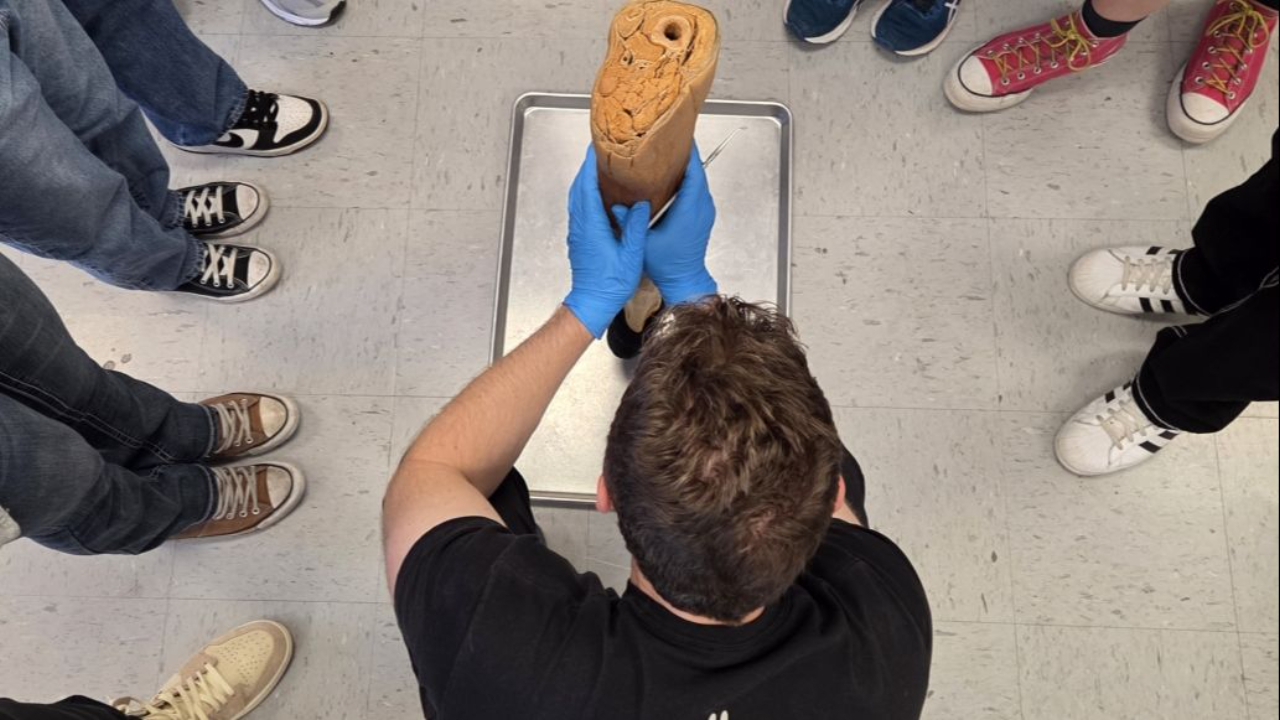
Using Cadaver-Based Visual Resources
Cadaver-based resources provide a level of detail and authenticity that illustrations and digital models can't replicate. These resources showcase the natural variations in color, texture, and proportion found in real human anatomy. For instance, you can see the actual thickness of muscle layers or the subtle color differences between organs - details that prepare you for what you'll encounter in clinical practice.
Institutions like the Institute of Human Anatomy specialize in using real human specimens to bridge the gap between theory and practice. This type of learning complements mnemonics by grounding your knowledge in realistic, hands-on context.
Sketching and Labeling for Active Learning
Sometimes, the old-school methods are still the most effective. Sketching anatomical structures engages your motor skills and reinforces what you’re learning visually. Research shows that drawing activates multiple cognitive processes - visual, spatial, verbal, and motor - making it a powerful tool for memorization.
For example, a study involving 416 medical students found that sketching anatomical regions before or after dissection significantly improved their retention of the material. Similarly, research from the University of Waterloo demonstrated that drawing is more effective for memory retention than simply writing or observing.
Start with simple line drawings to capture proportions and relationships. Try sketching a structure from memory, then compare it to a reference image to spot gaps in your understanding. Repeating this cycle of drawing, reviewing, and refining creates a feedback loop that helps solidify your knowledge.
"Drawing the studied anatomical region before or after the dissection session positively influences students' comprehension of anatomy. Encouraging the students to create their own atlas will facilitate their recalling and understanding of anatomical regions." - M. Bertrand
Creating your own anatomical atlas can take this learning method even further. It forces you to actively engage with the material and process it in a way that enhances both understanding and long-term retention. For instance, at the University of Illinois Chicago, Biomedical Visualization graduate students are required to sketch anatomy during their first semester, emphasizing how visual learning fosters a deeper, three-dimensional grasp of the human body.
3. Active Recall: Testing Your Knowledge
Active recall is a game-changer when it comes to locking in what you've learned. While visual aids help you grasp concepts, active recall takes it a step further by challenging your brain to retrieve information without prompts. This is a big deal - recognizing something might get you through a multiple-choice test, but being able to recall it prepares you for situations where there are no hints, like identifying structures in a clinical setting.
Here’s how it works: every time you actively recall information, the neural pathways tied to that memory get stronger. In contrast, passive methods like re-reading or highlighting don’t engage your brain as deeply. The result? Testing yourself regularly is far more effective for retention than passively reviewing your notes.
Quiz Yourself Regularly
Self-quizzing is one of the best ways to pinpoint weak spots before they trip you up in an exam. Push yourself with challenging quizzes to uncover what you don’t know yet.
For example, cover the labels on a diagram and try naming each structure. If you get stuck, resist the urge to peek at the answer right away. Instead, think through what you do know - what system is it part of? Where is it located? This process of piecing things together strengthens your understanding and builds connections between related ideas.
The timing of your quizzes also matters. Test yourself right after learning something new, then space out your review sessions over time. Research shows that spaced testing is far more effective for long-term retention compared to cramming everything into one sitting. For instance, students who quiz themselves at intervals retain material much longer than those who simply re-read or cram.
Another tip? Write your own quiz questions as you study. This forces you to engage with the material in a deeper way and anticipate what might show up on an exam. Instead of just memorizing that the femur is the longest bone in the body, challenge yourself with questions like, “What are the major landmarks of the femur?” or “How does the femur connect with other bones?”
Using Flashcards for Spaced Repetition
Flashcards may seem old-school, but paired with a spaced repetition system, they’re incredibly effective. Digital flashcards are especially helpful because you can review them at your own pace. You can spend more time on the cards that are harder for you and go through the ones you know well more quickly. This way, you focus on what needs the most work without wasting time on what you already know..
When creating anatomy flashcards, keep them specific and detailed. Break down complex topics into smaller, digestible pieces. For example, instead of one card for an entire organ, create multiple cards covering its location, function, and relationships to nearby structures. Adding images is also a smart move. A card with an unlabeled diagram of the brain forces you to identify a structure in context, which is much more effective than just memorizing a definition.
Take a multi-angle approach with your flashcards. For one structure, create cards that test its location, its role, and how it interacts with other systems. This mirrors the way you’ll need to think when applying your knowledge in clinical settings or exams.
To stay sharp, aim for daily study sessions of 15–20 minutes. This consistent practice keeps the material fresh in your mind and helps you develop automatic recall - an invaluable skill when you’re under pressure, whether in an exam room or during clinical rotations.
4. Memory Palaces: Storing Anatomy in Your Mind
The memory palace method taps into your brain's natural ability to remember spatial information, making it a powerful tool for mastering anatomy. This ancient technique works by linking complex facts to familiar locations - like your childhood home, your favorite coffee shop, or even your current apartment. By associating anatomical details with specific places, you create vivid mental connections that are much easier to recall.
What makes this method so useful for anatomy is its structural similarity to the human body. Just as organs have specific locations and relationships within the body, the information in your memory palace is organized in a clear, logical flow. For example, when you need to recall something intricate, like the path of blood through the heart or the layers of the skin, you can mentally "walk" through your palace, retrieving each piece of information in the correct order. Let’s break down how to create and use a memory palace for studying anatomy.
How to Build a Memory Palace for Anatomy
Start by choosing a location you know like the back of your hand - your childhood home is a great option. Identify key landmarks along a fixed route, such as the front door, the hallway, the living room, and the kitchen. Following a consistent path helps you organize and recall information more effectively.
Next, assign anatomical details to each landmark, making the associations as memorable as possible. The more bizarre or vivid the imagery, the better it sticks. For instance, you could imagine the olfactory nerve as a giant nose sniffing at your front door or visualize the optic nerve as a pair of eyeballs perched on your entryway table. These striking mental pictures make the information nearly impossible to forget.
To reinforce these connections, practice walking through your memory palace regularly. Take your time at first, visualizing each scene in detail. As you get more comfortable, speed up your mental walkthrough until you can recall the entire sequence effortlessly. This repetition strengthens your memory and makes retrieving the information almost automatic.
Practical Uses of Memory Palaces
Memory palaces are particularly effective for memorizing sequences and processes that follow a natural flow. For example, you could map the cardiac cycle to different rooms in your house: imagine deoxygenated blood entering through the hallway, lung circulation happening in the bathroom, and oxygenated blood returning to the kitchen. This spatial arrangement helps you visualize the process step by step.
For layered structures like the epidermis, you might use a multi-story building. Picture the basement as the stratum basale, where new skin cells are "born" - perhaps a nursery full of baby cells. The ground floor could represent the stratum spinosum, with spiky cells resembling tiny cacti. As you move up each floor, you encounter the remaining layers, ending with the penthouse as the stratum corneum, where old cells flake off like peeling paint.
The memory palace also shines when tackling lists without an obvious sequence, like the twelve cranial nerves. You could assign each nerve to a specific spot, with its function acted out in a dramatic scene. For example, imagine the trigeminal nerve as a three-headed monster in your dining room, controlling sensation in three areas of your face. Meanwhile, the facial nerve might be performing exaggerated expressions in front of your bathroom mirror.
To strengthen associations, group related structures together. If you're studying the respiratory system, you might picture the trachea as a giant tube running down your hallway, with bronchi branching into different rooms like a subway map.
5. Connecting Anatomy to Physiology for Better Understanding
Enhancing your anatomy knowledge becomes much more effective when you connect it to physiology. Anatomy focuses on the layout of structures, while physiology dives into how those structures work. By combining the two, you create stronger memory links and a deeper understanding of how the body operates.
Linking Structures to Their Functions
Always tie anatomical structures to their functions. This approach turns scattered facts into a clear and connected picture of the body's design. Instead of relying on rote memorization, you gain meaningful insights, making it easier to grasp and retain complex ideas. Just like mnemonics or active recall, associating structure with function strengthens long-term memory. Incorporate this practice into your review sessions to shift from passive memorization to active, engaged learning.
Conclusion: Mastering Anatomy Through Proven Techniques
Learning anatomy becomes much more approachable when you have the right strategies in your toolkit. The five techniques we’ve discussed - mnemonics, visual tools, active recall, memory palaces, and linking anatomy to physiology - each bring their own strengths to the table, catering to various learning styles and situations.
The real magic happens when you combine these methods. For example, pairing acronyms with 3D anatomy apps or using flashcards alongside memory palaces helps create multiple pathways in your brain for the same information. Linking the carpal bones to their function in wrist movement is a great way to strengthen your understanding while making the material more memorable.
By integrating these approaches into your study routine, you’ll build a more balanced and effective way of learning. Even just 15 minutes of active recall each day can make a noticeable difference, reinforcing neural connections and ensuring the material sticks far better than last-minute cramming.
It’s important to remember that no two learners are the same. Experiment with these techniques to discover what works best for you - what feels natural and fits seamlessly into your routine.
Each of these methods complements the others, creating a solid foundation for mastering even the most challenging anatomy topics. Start applying them today, and with consistent practice, you’ll find yourself navigating anatomy with confidence and ease.
FAQs
What are the best ways to combine memory techniques for studying anatomy effectively?
To get the most out of studying anatomy, try blending different memory techniques to reinforce your learning. For instance, combine mnemonics with visual aids like flashcards or 3D models. Mnemonics can break down complicated terms into simpler, memorable chunks, while visual tools help you connect those terms to the actual structures they represent.
Another strategy is pairing active recall with spatial mapping. Regularly quiz yourself by recalling anatomical terms or structures from memory, and associate them with specific spots on a diagram, model, or even an imagined mental map. This dual approach taps into different parts of your brain, boosting both comprehension and retention.
Mixing these methods can make your anatomy study sessions more interactive and productive, helping you grasp even the most complex topics with ease.
How can I use a memory palace to remember complex anatomy concepts?
A memory palace can be an incredibly effective way to memorize complex anatomy by tying information to familiar places. Start with a location you know inside and out - like your home - and assign specific anatomical details to different rooms or objects within it. For instance, picture the olfactory nerve as a dog sniffing around your front door, while the optic nerve becomes a glowing lightbulb in your living room. You can take it further by linking the branches of the trigeminal nerve to specific spots, such as imagining the ophthalmic division as a window in your house. By creating these vivid, location-based associations, you’ll find it much easier to recall even the trickiest concepts.
Why is it helpful to connect anatomy with physiology when studying?
Understanding the connection between anatomy and physiology can make it much easier to grasp how the body functions as a unified system. When you link the structure of a body part to its purpose, it paints a clearer mental picture, helping you remember and apply the information more effectively. This method not only boosts retention but also deepens your comprehension of how the body operates, which can be incredibly helpful during exams or practical scenarios.

