
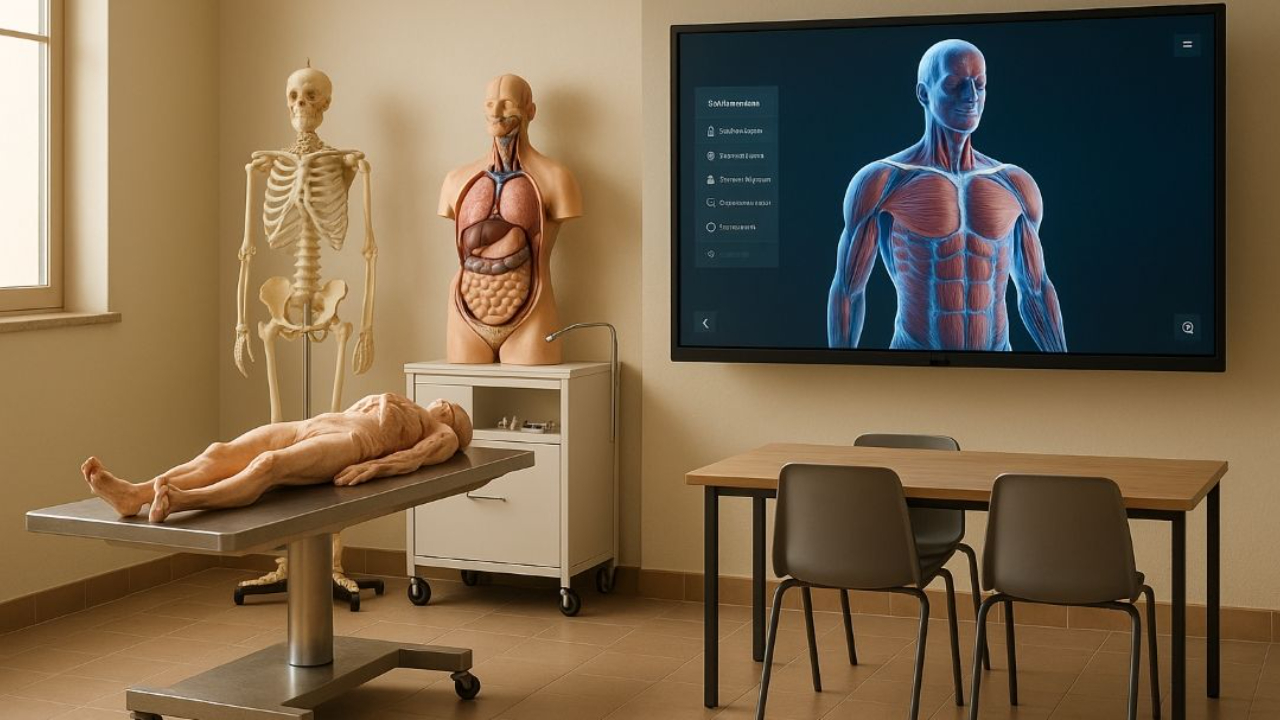
AI vs. Traditional Anatomy Teaching Methods
Jan 08, 2026Anatomy education is at a crossroads between cadaver-based learning and AI-powered tools. Here's the key takeaway: both methods have strengths, and combining them could offer the best results.
- Cadaver-based learning: Offers hands-on experience with real human tissue, teaching tactile skills and spatial understanding. However, it's expensive, limited by resources, and less accessible.
- AI tools: Provide unlimited practice, 24/7 access, and real-time feedback through virtual dissection, augmented reality (AR), and personalized systems like "AI Jonathan." These tools excel in accessibility and skill repetition but lack the tactile feedback of cadavers.
Quick Comparison
| Criteria | Cadaver-Based Learning | AI-Powered Tools |
|---|---|---|
| Hands-On Experience | Real tissue handling; essential for manual skills | Virtual; lacks physical interaction |
| Accessibility | Limited by cadaver availability and lab hours | 24/7 access; requires internet and devices |
| Cost | High recurring costs for specimens and facilities | High initial cost; lower ongoing expenses |
| Skill Development | Strong tactile and spatial understanding | Repetition-focused; real-time feedback |
| Scalability | Limited by resources and space | Scalable for large student populations |
Both approaches play critical roles. Cadaver labs provide irreplaceable tactile learning, while AI tools address resource constraints and offer flexibility. A blended model - starting with AI for theory and practice, followed by cadaver-based labs for hands-on learning - can help students develop both theoretical knowledge and practical skills.
➡️ Compare More Tech Options: Wearable Tech vs. Cadaver Labs: Key Differences
Anatomy teaching methods: evolution or extinction
Cadaver-Based and Classroom Teaching Methods
For over 300 years, medical schools have relied on cadaver dissection and in-person teaching to anchor their anatomy programs. This method combines lectures with hands-on lab sessions where students either perform dissections or observe instructors demonstrating anatomical structures. By engaging multiple senses - seeing, touching, and manipulating real tissues - students gain a tactile understanding of tissue textures, spatial relationships between organs, and the intricate three-dimensional layout of the human body. While this traditional approach offers invaluable practical learning, it is not without its challenges.
The Institute of Human Anatomy showcases how cadaver-based education remains relevant today by blending traditional methods with modern digital tools, offering interactive courses and study materials that center around real human specimens.
Strengths of Cadaver-Based Methods
Cadaver dissection offers a hands-on experience that digital tools simply cannot replicate. Handling real tissues helps students develop manual dexterity and confidence for clinical procedures. They learn how different structures feel, how they respond to manipulation, and how to navigate the complexities of the human body in a way that only physical dissection can provide.
Another key benefit is the spatial understanding gained through working with actual human specimens. Students explore tissue planes, trace nerve pathways, and observe how structures fit together in their natural context. Unlike textbook illustrations, which often depict idealized anatomy, cadavers reveal the reality of anatomical variation. Differences in vessel branches, organ placement, and structural anomalies prepare students for the unpredictability they’ll face in clinical practice.
Face-to-face interaction with expert instructors is another major advantage. Instructors can provide immediate feedback, correct missteps, and demonstrate techniques on the spot. This real-time guidance fosters a more effective learning environment, helping students avoid reinforcing mistakes.
Data also supports the effectiveness of traditional methods. Surveys show that 73.5% of students are satisfied with traditional anatomy lectures, compared to 56.0% for online lectures and just 21.5% for self-teaching with presentation materials. Additionally, 49.0% of students rank traditional lectures as their preferred learning method. These findings reflect the widespread belief that cadaver-based teaching delivers a richer educational experience, even with its logistical hurdles.
Beyond technical skills, working with cadavers instills a sense of respect for the donors who contribute to medical education. This experience fosters professionalism and ethical awareness, shaping students’ attitudes toward their future roles as healthcare providers. However, despite these benefits, cadaver-based teaching comes with notable limitations.
Limitations of Cadaver-Based Methods
One of the biggest challenges is resource scarcity. Maintaining a cadaver-based program requires significant investment in cadaver acquisition, preservation chemicals, specialized lab facilities, and trained staff. Institutions also face costs for biohazard disposal, safety compliance, and administrative oversight to ensure respectful handling of human remains. These expenses can be prohibitive, especially for smaller schools or those in resource-limited areas.
Another limitation is restricted access. Not all students get equal opportunities to perform dissections or thoroughly explore every anatomical structure. Limited lab space and cadaver availability often mean students must share resources, leading to inconsistent hands-on experiences. Additionally, the curriculum’s fixed schedule may not accommodate individual learning paces, leaving some students struggling to keep up.
The shift to remote learning during the pandemic highlighted another drawback. Studies comparing pre-pandemic and pandemic-era teaching revealed a decline in exam performance when instruction moved online. For example, exam scores in musculoskeletal system anatomy and neuroanatomy dropped significantly during remote learning periods. This underscores the effectiveness of traditional methods for knowledge retention but also exposes their reliance on in-person instruction, which can be disrupted by external circumstances.
Finally, most students - around 66.5% - believe remote teaching cannot fully replace traditional anatomy methods. This sentiment reflects the irreplaceable value of cadaver-based learning while acknowledging its limitations in terms of accessibility and scalability. These challenges have led to the integration of AI tools, which aim to complement traditional methods and address some of these practical constraints.
AI-Powered Anatomy Teaching Tools
Traditional anatomy education has long relied on cadaver-based learning, but challenges like limited resources and accessibility have sparked a shift toward AI-powered technologies. These tools are not meant to replace cadavers but to complement them, offering repeatable and flexible learning experiences. From virtual dissection to personalized learning systems, AI is reshaping how anatomy is taught.
What AI Tools Can Do in Anatomy Education
Virtual dissection software provides a simulated environment where students can practice dissections repeatedly, free from the constraints of limited cadaver specimens. These tools deliver real-time feedback, helping students refine their skills and overcome resource shortages.
Virtual Reality (VR) and Augmented Reality (AR) bring anatomy lessons to life in ways that go beyond textbooks and static charts. Students can explore 3D models of anatomical structures, interact with them from multiple angles, and even perform virtual dissections. This flexibility allows students to practice anytime, anywhere, making it especially helpful for those who need extra time to grasp complex concepts or review material outside of scheduled lab sessions.
AI-powered personalized learning systems take things a step further. These platforms analyze students' learning behaviors and performance in real time, tailoring study paths to address individual weaknesses. For example, the Institute of Human Anatomy’s "AI Jonathan" chatbot provides 24/7 support, offering conversational explanations, personalized study resources, and insights into major body systems. It’s like having a tutor on demand, helping students break down challenging material and review it efficiently.
Research supports the benefits of AI in anatomy education. A meta-analysis of 11 randomized controlled trials involving 786 medical students found that AI-based instruction significantly improved practical skills, with a standardized mean difference of 0.63 compared to traditional methods. Students also reported higher satisfaction with their learning experience, highlighting the added value of these tools.
Instructors benefit, too. AI enables teachers to monitor student progress in real time, adjust lesson plans, and fine-tune teaching methods based on data feedback. This creates a dynamic, responsive learning environment where teaching evolves alongside student needs.
AI also excels at simulating clinical scenarios, exposing students to diverse anatomical variations and pathological conditions that are hard to replicate in traditional settings. These virtual experiences allow students to encounter rare cases without waiting for them to appear in cadaver specimens, broadening their clinical understanding.
However, these advancements come with their own set of challenges.
Limitations and Challenges of AI Tools
Despite its promise, AI-powered anatomy education has limitations. One major drawback is the lack of tactile feedback. While VR and AR offer immersive visual experiences, they cannot replicate the physical sensation of handling tissues or the subtle cues that inform clinical decision-making. This gap is particularly critical for developing the manual skills and confidence required in surgical procedures.
Another hurdle is the high initial cost of implementing AI and VR/AR systems. Building and maintaining this advanced infrastructure demands significant investment, which may be out of reach for smaller or underfunded institutions. Instead of narrowing educational gaps, this could unintentionally widen them.
Access to technology presents another challenge. Not all students have reliable internet or the necessary hardware to use AI-powered platforms effectively. While these tools aim to improve accessibility, they risk creating new inequalities based on technological access rather than physical resources.
There’s also evidence that transitioning from traditional methods to AI-based learning can impact exam performance. Studies suggest that AI tools alone may not fully replicate the comprehensive learning experience provided by traditional approaches, especially without thoughtful integration and support.
Concerns about overreliance on technology and academic integrity further complicate matters. Without standardized training protocols for instructors or clear frameworks for evaluating these tools, it’s difficult to measure their true impact. Factors like students’ prior learning habits can skew results, making it challenging to assess AI’s effectiveness.
Additionally, many studies on AI in education are limited in scope, often focusing on short-term implementations. Research shows that AI’s benefits become more pronounced over extended periods, particularly in practice-oriented courses. This suggests that long-term integration is key to unlocking its full potential.
AI-driven Large Language Models have also made strides, improving performance on anatomy-related multiple-choice questions. However, these tools work best when used alongside traditional methods rather than as a standalone solution. Combining AI with established teaching practices ensures a more balanced and effective approach to anatomy education.
Knowledge Acquisition and Practical Skill Development
When it comes to preparing students for applying anatomy in real-life scenarios, the debate over which method - traditional or AI-based - is more effective doesn’t have a simple answer. Each approach shines in different areas of learning.
Learning Theoretical Concepts
Traditional lectures remain popular, with 73.5% of students expressing satisfaction due to the direct feedback from instructors. On the other hand, AI-powered platforms bring a personalized edge, tailoring content to an individual’s specific learning needs. These platforms address a common challenge in traditional teaching: the "one-size-fits-all" model. By identifying gaps in understanding, AI tools provide targeted reviews based on a learner's unique progress.
Research shows that both AI and traditional methods are equally effective in building a strong foundation of theoretical knowledge. However, their strengths begin to diverge when it comes to practical skill development. For instance, Microsoft Copilot, tested on 325 multiple-choice questions from a Gross Anatomy course, achieved 73.9% accuracy - ranking third among similar AI systems but falling about 19% short of the top performer. This result highlights AI’s potential to enhance theoretical understanding, which serves as a critical base for hands-on skills.
Hands-On Learning and Practical Skills
Practical training is where the differences between these methods become more pronounced. Cadaver dissection offers an irreplaceable experience, providing tactile feedback and precise spatial awareness. Yet, AI-based methods have shown measurable advantages in certain skill areas, with studies reporting better outcomes for practical skills using AI tools (SMD = 0.63, p = 0.02). This is largely due to the ability of AI platforms to facilitate repetitive practice with immediate feedback.
The key to understanding this seeming contradiction lies in how "practical skills" are defined. AI tools excel in developing spatial visualization and procedural repetition. Virtual dissection software, for example, allows students to repeatedly simulate dissection exercises while receiving real-time feedback on their performance. These tools enable users to explore anatomical structures from various perspectives and practice techniques as often as needed, free from the limitations of physical cadaver specimens.
One standout advantage of AI systems is their real-time feedback mechanism. Unlike traditional instructor feedback, which often comes after a dissection is completed, AI platforms provide instant performance reviews. Automated grading and tutoring systems help students quickly identify errors and adjust their strategies on the spot.
That said, AI tools can’t replicate the hands-on experience of working with real human cadavers. The tactile exposure and manual dexterity gained through cadaver dissection remain essential for clinical proficiency. Institutions like the Institute of Human Anatomy emphasize this by incorporating cadaver-based learning into their programs. Meanwhile, their AI-powered guide, Jonathan, offers 24/7 support to help students grasp complex concepts and navigate body systems. However, it’s clear that Jonathan is intended to complement - not replace - the irreplaceable experience of cadaver dissection.
Student Engagement and Learning Experience
How students interact with anatomy material plays a critical role in shaping their learning outcomes. Both traditional cadaver-based methods and AI-powered tools bring unique strengths to the table, offering distinct ways to engage learners. Choosing the right approach - or blending the two - depends on the specific goals of educators and students.
Engagement in Cadaver-Based Settings
Working with real human cadavers offers an immersive learning experience that engages multiple senses in a way textbooks or screens simply cannot match. In a cadaver lab, students physically touch, manipulate, and explore anatomical structures in three dimensions. This hands-on approach provides a depth of understanding that’s difficult to replicate with digital tools.
Small-group work in these labs encourages collaboration, as students discuss their observations, challenge interpretations, and solve anatomical puzzles together. This collaborative environment fosters accountability and a sense of shared purpose. Moreover, face-to-face interactions with instructors provide spontaneous guidance and immediate answers, creating valuable learning moments. It’s no surprise that traditional cadaver-based teaching remains the preferred method for many students.
What It's Like Working With Dead Bodies
Engagement with AI Tools
AI tools, on the other hand, bring a different kind of interactivity and innovation to anatomy education. Virtual and augmented reality platforms allow students to manipulate anatomical models from various angles, zoom in on intricate details, and practice dissection techniques repeatedly - all without the limitations of physical specimens. In fact, students using AI-based methods have reported higher satisfaction with their learning experiences compared to traditional approaches.
Gamification is another standout feature of AI platforms. By incorporating progress tracking, achievement badges, and adaptive challenges, these tools motivate students to stay engaged. For example, the Institute of Human Anatomy’s AI assistant, Jonathan, offers 24/7 support with real-time answers, personalized study assistance, and conversational explanations to demystify complex concepts. This makes AI tools a powerful complement to traditional cadaver-based learning. Additionally, digital tools or platforms that offer interactive anatomy models, quizzes, and guided exercises such as Anatomy.app, Teach Me Anatomy, or Anatomy Bootcamp can further complement both AI tools and cadaver-based learning.
AI tools also promote independent learning by encouraging students to ask questions, solve problems, and think critically. With real-time feedback, learners can quickly pinpoint areas where they’re struggling and access targeted review materials, creating a customized learning path tailored to their needs.
The impact of specific technologies has been noteworthy. For instance, 79.17% of students rated tools like the magic mirror and Anatomage as excellent for improving their understanding of 3D anatomy, while 82% of students at the University of Bologna found AEducaAR to be an enjoyable learning tool. Additionally, the flexibility of AI tools allows students to study anytime, anywhere, catering to diverse schedules and study habits.
However, it’s important to note that while these tools have boosted engagement and participation in anatomy lessons, they haven’t always translated to better exam performance. This highlights a key point: increased engagement doesn’t necessarily guarantee improved learning outcomes.
Both cadaver-based methods and AI tools bring distinct benefits to the learning experience. Cadaver labs offer tactile, social, and instructor-led learning, while AI tools provide personalized, interactive, and flexible support. Together, these approaches have the potential to complement each other, creating a well-rounded and effective blended learning model.
Blended Learning: Combining Cadaver-Based and AI Approaches
Blended learning, which merges cadaver-based instruction with AI tools, offers a well-rounded approach to anatomy education. By combining the strengths of each method, this hybrid model addresses their individual limitations and creates a richer learning experience. It’s a strategy that not only optimizes resources but also enhances student outcomes, as explored below.
Benefits of Blended Learning
This approach moves beyond the limitations of traditional teaching methods by pairing the personalized, adaptive capabilities of AI with the tangible, hands-on experience of cadaver-based training. Research indicates that combining these methods improves both practical skills and student satisfaction, making it especially effective for extended programs and practice-heavy courses.
One of the challenges with cadaver-based learning is the limited availability of specimens, along with ethical and regulatory concerns. By incorporating AI tools - such as virtual dissection platforms and simulations - students can repeatedly practice without straining these finite resources.
Institutions like the Institute of Human Anatomy illustrate how AI can complement cadaver-based training. For example, AI systems provide 24/7 access to interactive study tools, answer anatomy and physiology questions, and guide students through detailed body systems. This constant availability enhances learning by offering support that cadaver labs alone cannot provide.
How to Implement Hybrid Models
To successfully integrate AI into cadaver-based programs, institutions need a thoughtful and strategic approach. Here are some key steps:
- Choose the Right Technologies: Select virtual dissection tools and 3D imaging platforms that enhance, rather than replace, cadaver-based labs. AI tools can help students explore anatomical structures through interactive models before transitioning to hands-on dissection.
- Sequence Learning Activities Wisely: Start with AI tools to build foundational knowledge, making cadaver lab time more productive. After lab sessions, students can revisit AI platforms for review and to reinforce complex concepts.
- Train Faculty and Allocate Resources: Faculty training is critical to help instructors use AI tools effectively, interpret learning data, and adjust their teaching methods. Clear protocols should also be established to balance the use of virtual and physical dissection resources.
- Gather Feedback and Use Data: Collecting student feedback and performance metrics is essential. For instance, while 73.5% of students value traditional cadaver-based learning, 69% find online lectures helpful as a supplementary tool. These insights confirm that a blended approach aligns with student needs while modernizing the curriculum.
- Incorporate New Teaching Methods: Combine AI tools with strategies like flipped classrooms, case-based learning, and gamification to further enrich the experience. Technologies like augmented and virtual reality can also provide immersive, interactive dissection exercises with instant feedback.
Cost, Accessibility, and Scalability
The financial and logistical aspects of anatomy education play a huge role in determining the teaching methods institutions can adopt. While traditional cadaver-based programs and AI-driven tools each bring unique benefits to the table, they differ significantly in terms of cost, accessibility, and scalability.
Affordability and Resource Allocation
Cadaver-based anatomy programs come with hefty recurring costs. Institutions must continually budget for acquiring cadavers, preservation chemicals, and specialized storage facilities. Add to that the need for compliance with strict ethical and regulatory standards. Each cadaver demands careful handling, climate-controlled storage, and proper disposal, all of which drive up expenses. As enrollment grows, so do the costs - more specimens, expanded lab spaces, and additional trained staff become necessary. On top of that, the infrastructure requirements, like advanced ventilation systems, dissection tools, and health-compliant facilities, can be a financial strain, especially for smaller institutions or those with limited resources.
On the other hand, AI-powered anatomy tools involve a significant upfront investment in software, licensing, and the necessary tech infrastructure. However, once operational, the cost per student remains minimal. A single AI system can accommodate countless students simultaneously without requiring additional physical resources or space. That said, there are ongoing expenses for technology upkeep, software updates, and staff training to ensure smooth integration into the curriculum.
Studies back up the cost-efficiency of AI-based methods when scaled. For instance, a meta-analysis of 11 randomized controlled trials involving 786 medical students demonstrated that thoughtfully implemented AI instruction led to better practical skill development outcomes.
These financial dynamics naturally lead to a discussion about how scalable and accessible each approach truly is.
Scalability and Accessibility
Cadaver-based programs face inherent limitations that can restrict access to quality anatomy education. Physical labs are constrained by the number of specimens, available lab space, and fixed operating hours. This setup limits enrollment and the amount of hands-on experience students can gain. Additionally, students in rural or underserved areas often lack access to institutions equipped with cadaver labs, deepening educational disparities.
AI-powered tools help bridge these gaps. Virtual dissection platforms, 3D anatomical models, and interactive simulations can be accessed from anywhere with an internet connection. For example, the Institute of Human Anatomy’s AI Jonathan offers 24/7 personalized study assistance, removing the need for physical travel or rigid schedules. This flexibility is particularly valuable for working professionals, students with caregiving responsibilities, and others who struggle to fit traditional lab hours into their lives.
Beyond accessibility, virtual tools allow students to repeat exercises as many times as needed, with real-time feedback to guide their learning. This kind of unlimited practice is something cadavers simply cannot provide. Additionally, digital platforms sidestep many of the ethical and regulatory challenges tied to cadaver use, further reducing costs and expanding availability.
For institutions looking to balance quality and scalability, a blended learning approach could be the best of both worlds. By combining limited cadaver resources with AI tools, schools can offer hands-on sessions in rotation while ensuring students have continuous access to virtual practice environments.
Conclusion: Weighing the Pros and Cons
When it comes to teaching anatomy, the discussion isn't about choosing between AI tools and traditional cadaver-based methods - it's about recognizing how each serves different purposes in medical education. A study involving 786 medical students highlights this balance: while traditional methods provide a strong theoretical foundation, AI-based tools excel in developing practical skills and boosting student satisfaction.
Cadaver-based learning, such as the programs offered by the Institute of Human Anatomy, delivers an unmatched hands-on experience. Students gain exposure to the natural variations, textures, and spatial relationships of human anatomy. However, this approach comes with limitations: finite specimens, restricted lab hours, high costs, and accessibility barriers.
AI-powered tools like AI Jonathan address many of these challenges. They provide 24/7 access, unlimited practice opportunities, and instant feedback, enabling students to explore complex anatomical topics, revisit materials at their own pace, and receive clear explanations. The Institute of Human Anatomy's digital reach - boasting over 24 million followers and 2 billion video views - shows how online platforms can expand access to anatomy education far beyond the confines of physical labs.
By examining the strengths of both approaches, clear strategies emerge for students and educators alike. For students, AI tools are invaluable for quick clarifications, personalized study sessions, and efficient reviews, especially when building a theoretical foundation. Meanwhile, cadaver-based learning is essential for developing tactile skills, understanding anatomical variations, and experiencing the physical realities that digital tools can't replicate.
For educators and institutions, the choice depends on goals and resources. AI platforms are ideal for schools with limited budgets or large student populations, offering scalable, high-quality education. Research shows that AI tools perform well in practice-focused courses and for extended study periods. On the other hand, cadaver resources should be reserved for critical hands-on sessions, complemented by AI tools for ongoing support.
The best approach combines the strengths of both methods. A hybrid model allows students to practice dissection techniques virtually, receive immediate feedback, and then apply that knowledge in cadaver labs. This blend ensures students benefit from AI's personalized learning while still gaining the irreplaceable experience of working with real human anatomy.
As anatomy education evolves, the goal isn't to replace traditional methods with technology but to enhance them. By integrating AI with cadaver-based instruction, institutions can prepare students more comprehensively for healthcare careers, bridging the gap between modern innovation and time-tested practices. With thoughtful implementation, this blended approach can meet the diverse needs of future medical professionals as anatomy education embraces smarter, tech-driven solutions.
FAQs
How does combining AI tools with traditional anatomy teaching methods improve learning outcomes?
Combining AI tools with traditional anatomy teaching methods creates a powerful approach to learning by merging the best of both worlds. AI-driven tools deliver tailored guidance, instant responses to questions, and interactive features that simplify even the most challenging topics. Meanwhile, traditional practices, such as working with real human cadavers, provide hands-on tactile and visual experiences that are irreplaceable for deepening comprehension.
This combination allows students to gain a well-rounded education, enhancing their ability to retain and apply knowledge effectively in practical settings.
What challenges do institutions face when incorporating AI tools into cadaver-based anatomy programs?
Integrating AI tools into cadaver-based anatomy programs comes with its own set of challenges. A key concern is ensuring that AI specifically * enhances during the learning process. Working with real human cadavers offers irreplaceable tactile and visual insights already in the anatomy curriculum, making it vital to maintain a careful balance between traditional methods and AI-driven approaches.
Another significant challenge lies in the financial and resource demands of bringing AI technology into the classroom. Institutions may need to allocate budgets for new software, hardware, and staff training to ensure effective use of these tools. Moreover, not everyone might welcome this shift. Both educators and students who are more comfortable with traditional methods may show resistance to adopting AI. Overcoming these barriers requires thoughtful communication about how AI can serve as a valuable addition, enriching the learning experience rather than replacing the hands-on aspects that make cadaver-based anatomy unique.
How do AI-powered tools make anatomy education more accessible and scalable compared to traditional cadaver-based methods?
AI-driven anatomy tools make learning more accessible by enabling students to study whenever and wherever they want - no physical cadavers or lab spaces required. This approach also works well for large groups, offering tailored learning experiences to students no matter where they are.
These tools bring anatomy to life with 3D simulations, provide real-time feedback, and adjust to each student's learning pace. This combination makes them a practical and budget-friendly choice for anatomy education.

