

Neural Adaptations to Resistance Training
Mar 27, 2026When you start resistance training, much of the initial strength gain over thefirst few weeks comes from your nervous system working more efficiently, improving muscle activation and coordination, although muscle tissue can also begin to adapt during this time. You can learn human anatomy in-depth through real cadaver courses to better understand these systems. Here's what happens:
- Faster Strength Gains: Early progress is driven largely by neural changes, with muscle growth contributing more over time.
- Improved Motor Unit Recruitment: More muscle fibers are activated, increasing force output.
- Optimized Neural Signals: Your brain reduces "neural brakes" and enhances signal efficiency.
- Better Coordination: Movement patterns become smoother, with less interference from opposing muscles.
How the Body Builds Incredible Strength Without Getting Bigger
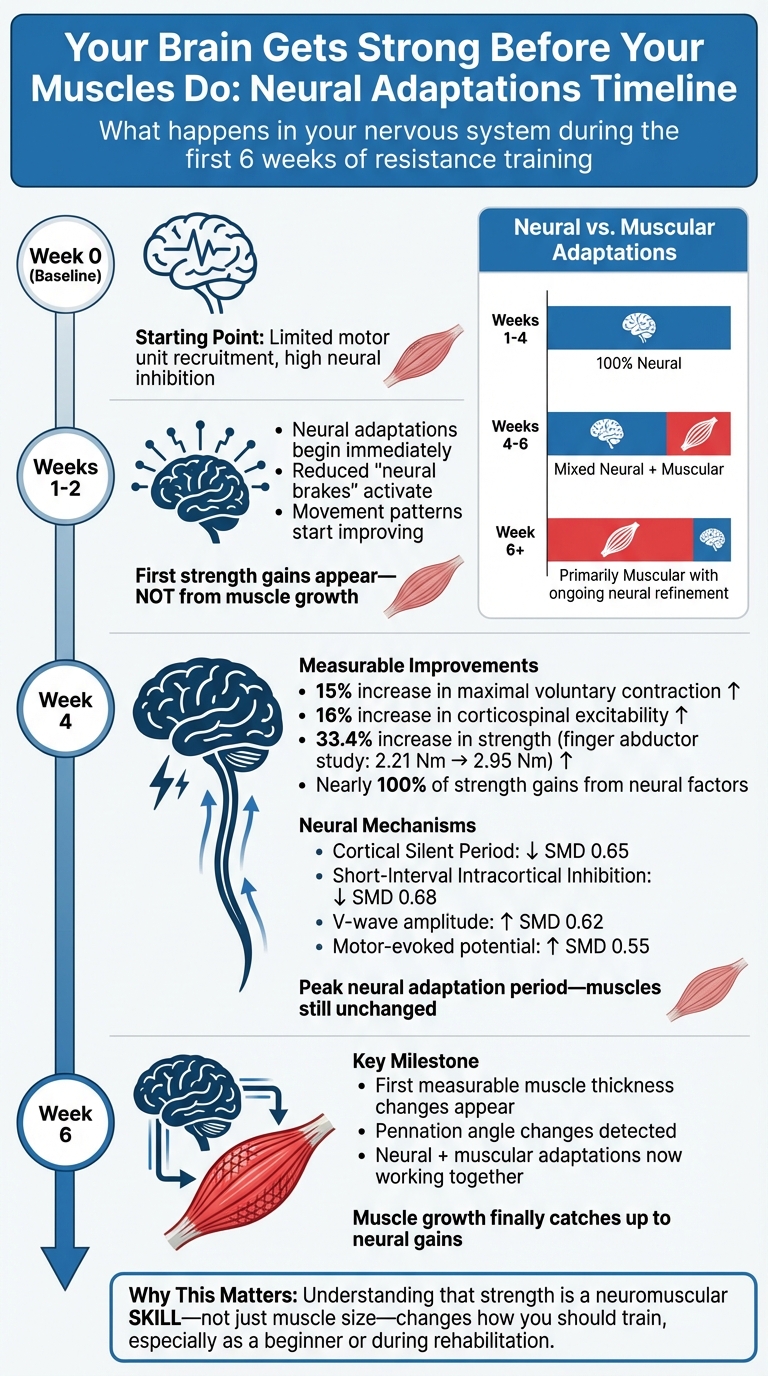
Neural Adaptations Timeline: First 6 Weeks of Resistance Training
How Neural Changes Drive Strength Gains
Neural Factors in Early Strength Gains
Your nervous system adapts faster than your muscles. During roughly the first 4 weeks of resistance training, strength gains are thought to be predominantly, though not exclusively, due to neural adjustments rather than muscle growth. That’s why you’ll notice you can lift heavier weights before your muscles actually look bigger.
"Neural factors accounted for the significant improvements observed during the first 4 weeks of an 8-week resistance-training program." – Moritani and deVries
A study from the University of Stirling, published in April 2023, tracked 40 participants over a 6-week lower-limb resistance program. Led by Dr. Wilson, the research found that after just 4 weeks, participants experienced a 15% boost in maximal voluntary contraction and a 16% increase in corticospinal excitability. However, measurable changes in muscle thickness and pennation angle didn’t show up until after 6 weeks, underscoring that neural adaptations come first.
Resistance training also reduces "neural brakes" - the body’s protective mechanisms that limit how much force you can produce. A meta-analysis revealed that training lowers the cortical silent period (SMD 0.65) and short-interval intracortical inhibition (SMD 0.68), while increasing neural drive, as shown by higher V-wave amplitude (SMD 0.62).
Improved Motor Unit Recruitment
Muscles work through motor units, which consist of muscle fibers controlled by a single nerve. The more motor units you can activate at once, the stronger you’ll be. Resistance training enhances your nervous system’s ability to recruit these units efficiently.
Training decreases motor unit recruitment thresholds and increases firing rates, which can substantially increase force output, even before visible muscle growth occurs. It also improves synchronization of motor unit activation, which is key for explosive movements.
"Increased force production following resistance training is accompanied by decreased motor unit recruitment threshold and increased discharge rate." – Jakob Škarabot, School of Sport, Exercise and Health Sciences, Loughborough University
These changes align with Henneman's Size Principle, which states that motor units are recruited from smallest (slow-twitch) to largest (fast-twitch) as force demands rise. Training enhances access to high-threshold fast-twitch units, which are critical for peak strength. These motor unit adaptations set the stage for further changes in the brain and spinal cord.
Brain and Spinal Cord Changes
Motor Cortex Plasticity
The motor cortex, the brain's hub for initiating voluntary movements, undergoes noticeable changes with resistance training. One key shift is the increase in corticospinal excitability, which improves the efficiency of motor unit recruitment. This means your brain becomes better at activating the muscles you need for a task.
Resistance training also reduces Short-Interval Intracortical Inhibition (SICI), a mechanism that typically limits neural output. According to meta-analysis data, SICI decreases with a standardized mean difference (SMD) of 0.68 after resistance training. Think of this as lifting a brake that usually restricts your neural signals. Similarly, the Cortical Silent Period - another measure of inhibitory activity - shortens by an SMD of 0.65, further enhancing neural efficiency.
"Strength training reduces the synaptic efficacy of inhibitory networks in M1 and corticospinal pathways, indicating a new neural adaptation to strength training." – Liang & Liu, School of Physical Education, Liaoning Normal University
These adaptations align with increased neural drive, where the motor cortex not only recruits more motor units but also boosts their firing rates during muscle contractions. Evidence for this comes from an increase in motor-evoked potential amplitude during voluntary contractions, which improves by an SMD of 0.55. Essentially, your brain gets better at sending stronger, more coordinated signals to your muscles.
While these changes refine how the brain controls movement, the spinal cord also adapts to relay these signals more effectively.
Spinal Cord Changes
A study from the University of Queensland, published in October 2002, followed 16 participants through a 4-week resistance training program focused on the index finger abductors. Participants completed 12 training sessions (three per week) and saw a 33.4% increase in maximal voluntary contraction torque, rising from 2.21 Nm to 2.95 Nm. Neurophysiological testing showed that the relationship between motor-evoked potential size and torque shifted significantly, highlighting functional changes in spinal cord circuitry rather than just cortical adjustments.
"Resistance training changes the functional properties of spinal cord circuitry in humans, but does not substantially affect the organisation of the motor cortex." – Timothy J. Carroll, Neurophysiology Laboratory, University of Alberta
One notable spinal adaptation is the increased V-wave amplitude (SMD 0.62), which reflects stronger volitional signals traveling from the brain to the motor neuron pool via the spinal cord. This means your brain can send more powerful instructions to your muscles. Emerging evidence, especially from animal studies and indirect human measures, suggests that the reticulospinal tract may adapt to strength training by strengthening its connections to spinal motor neurons, supporting tasks that require high force and coordination.
Why You REGAIN Strength, Size, & Skills FASTER: Muscle Memory
Neuromuscular Coordination and Efficiency
Resistance training doesn’t just make you stronger - it also fine-tunes how your muscles and nervous system work together. By improving coordination and refining motor signals, your body becomes more efficient at generating force and controlling movement.
Reduced Antagonist Coactivation
When you perform a bicep curl, your triceps (the opposing muscle group) naturally activate slightly to stabilize the joint. This is called antagonist coactivation, and while it’s helpful for joint protection, it can also limit the force your biceps produce. Resistance training teaches your nervous system to dial back this unnecessary activation, allowing your primary muscles (agonists) to work more effectively.
"A reduction in antagonist co-activation would allow increased expression of agonist muscle force, while an increase in antagonist co-activation is important for maintaining the integrity of the joint." – Gabriel, D.A., et al., Sports Medicine
This adjustment happens quickly, as your central nervous system learns to better inhibit opposing muscles. Research suggests that well‑trained and elite athletes often show lower antagonist co‑activation than recreational lifters, which likely contributes to more efficient force production. That said, a small amount of antagonist activity is still essential for joint stability and injury prevention.
While reducing interference from opposing muscles is key, improving the precision of your motor signals takes coordination to the next level.
Improved Movement Precision
Resistance training doesn’t just make your muscles stronger - it also makes their activation more precise. By lowering motor unit recruitment thresholds, and in some tasks reducing variability in their firing, your nervous system can produce smoother and more consistent muscle contractions. This means steadier movements, whether you’re holding a weight in place or performing a complex lift.
These improvements are highly specific to the movements you practice. For example, metronome‑paced resistance training has been shown in some studies to markedly increase corticospinal excitability and enhance motor unit recruitment compared with baseline, though the exact size of these changes varies by protocol and population. Over time, this fine-tuning transforms inefficient, jerky movements into smooth, controlled, and powerful actions.
Through a combination of reduced antagonist interference and refined signal precision, resistance training helps your body move with greater efficiency and control.
Practical Applications for Training
Designing Effective Training Programs
Understanding how the nervous system adapts to resistance training is key to creating programs that deliver results. For beginners, it's all about mastering foundational strength movements. These exercises prioritize efficient motor patterns and neural learning, which are crucial during the early stages. Since novices have a larger "adaptive reserve", they respond quickly to simple progressive overload methods without needing overly complex strategies. In fact, during the first few weeks, most progress is thought to come from neural adaptations, with structural muscle changes becoming more important over time. This makes proper movement patterns a cornerstone for long-term success.
The weight you choose plays a big role in shaping neural outcomes. For instance, lifting heavy loads (≥80% of your 1RM) leads to greater improvements in voluntary activation and EMG amplitude. It also reduces the "neural cost" needed to produce submaximal force, compared to lighter loads (30% 1RM). Athletes aiming to boost maximum strength and power can also benefit from explosive and ballistic exercises, which are associated with neural adaptations that support rapid force production, including task‑specific changes in motor unit firing.
Another effective approach is rhythmic, metronome-paced training. By controlling tempo - for example, using a one-second concentric and one-second eccentric phase - some studies show larger increases in corticospinal excitability and greater reductions in cortical inhibition than lifting at a self‑determined pace, though the exact size of these changes varies.
Applying Neural Changes to Movement Performance
These neural adaptations don't just stay in the gym - they translate into better performance in sports, rehabilitation, and everyday life. However, specificity is key. Neural changes are highly specific to the movement pattern, contraction type, and speed you train with. For example, strength gains from squats may not fully carry over to a leg press unless that specific movement is also practiced, because neural adaptations are highly task‑specific.
In rehabilitation and injury recovery, understanding cross-education is particularly useful. Training one limb can actually increase strength in the opposite limb through neural transfer. Additionally, mental practice - like imagining muscle contractions - can increase the excitability of brain areas involved in planning movements, making it a valuable tool when physical training isn't an option.
For elite athletes, breaking through plateaus often benefits from advanced techniques like eccentric overload, velocity‑based training, and structured periodization. Older adults can benefit from neuromuscular techniques such as antagonist‑to‑agonist proprioceptive neuromuscular facilitation (PNF) patterns, which aim to improve tension development and stability, although research on specific protocols is still emerging.
Conclusion
When it comes to building strength, most people zero in on muscle size. But here's the thing: early strength gains are largely driven by neural adaptations in your brain and spinal cord. A meta-analysis of 30 studies with 623 participants revealed some fascinating changes: resistance training boosts motor-evoked potential amplitude, reduces cortical inhibition, and enhances neural drive to muscles. These neural changes directly improve movement efficiency and strength.
Grasping these mechanisms can completely shift how you approach training. Whether you're learning basic exercises, breaking through a plateau as an athlete, or rebuilding strength after an injury, understanding that strength is a neuromuscular skill can reshape your strategy. For example, the cross-education effect - where training one limb improves strength in the opposite limb - proves just how central neural adaptations are.
The main takeaway? Resistance training rewires your nervous system for better performance. By focusing on proper movement patterns, the right loads, and specific exercises, you can train your body to move more efficiently, get stronger, and recover more effectively.
FAQs
How can I tell if my strength gain is neural or muscle growth?
Strength improvements early in training are often the result of neural adaptations. This includes better neuromuscular efficiency, such as improved motor unit recruitment and synchronization. These changes happen fast - usually within the first few weeks. In contrast, muscle growth (hypertrophy) takes longer, developing over weeks or even months, and leads to noticeable increases in muscle size. If you're gaining strength quickly without visible size changes, it's likely due to neural adaptations at work.
What type of lifting best enhances neural drive and motor unit recruitment?
Lifting relatively heavy loads, around 75–85% of your one‑rep max (1RM), is effective for boosting neural drive and motor unit recruitment, especially when the goal is maximal strength. At this intensity, your nervous system is pushed to work harder, improving coordination and making your muscles fire more efficiently.
How do I use cross-education if one limb is injured?
When dealing with an injured limb, you can use cross-education by focusing on unilateral resistance training with the healthy limb. This approach taps into neural adaptations that help transfer strength improvements to the injured side. These adaptations likely include heightened corticospinal excitability and shifts in motor unit activity. By consistently training the healthy limb over several weeks (often 4–8 or more), you can help preserve strength and support recovery in the injured limb.

