
Force-Velocity Relationship: Aging and Muscle Function
May 22, 2026Aging impacts how muscles produce force and speed, leading to reduced power and slower movements. Here's what you need to know about human anatomy and muscle function:
- Dynamic performance declines faster than static strength: Older adults lose around 40% of power in knee extensors at high speeds, compared to roughly 20% lower isometric strength in some studies.
- Muscle composition changes: Fast-twitch fibers (Type II) tend to atrophy more than slow-twitch fibers (Type I) with age, leading to a relative shift toward a slower, more fatigue‑resistant profile, although this does not fully compensate for losses in strength and power.
- Knee extensors vs. ankle dorsiflexors: Knee extensors face sharper declines in power, affecting tasks like standing or climbing stairs. Ankle dorsiflexors, used during walking, retain more function.
These changes highlight the need for exercise programs focused on power and speed to maintain mobility and reduce fall risks.
Young vs Aging Muscle Performance: Force-Velocity Comparison
1. Young Muscle Function
Force-Velocity Dynamics
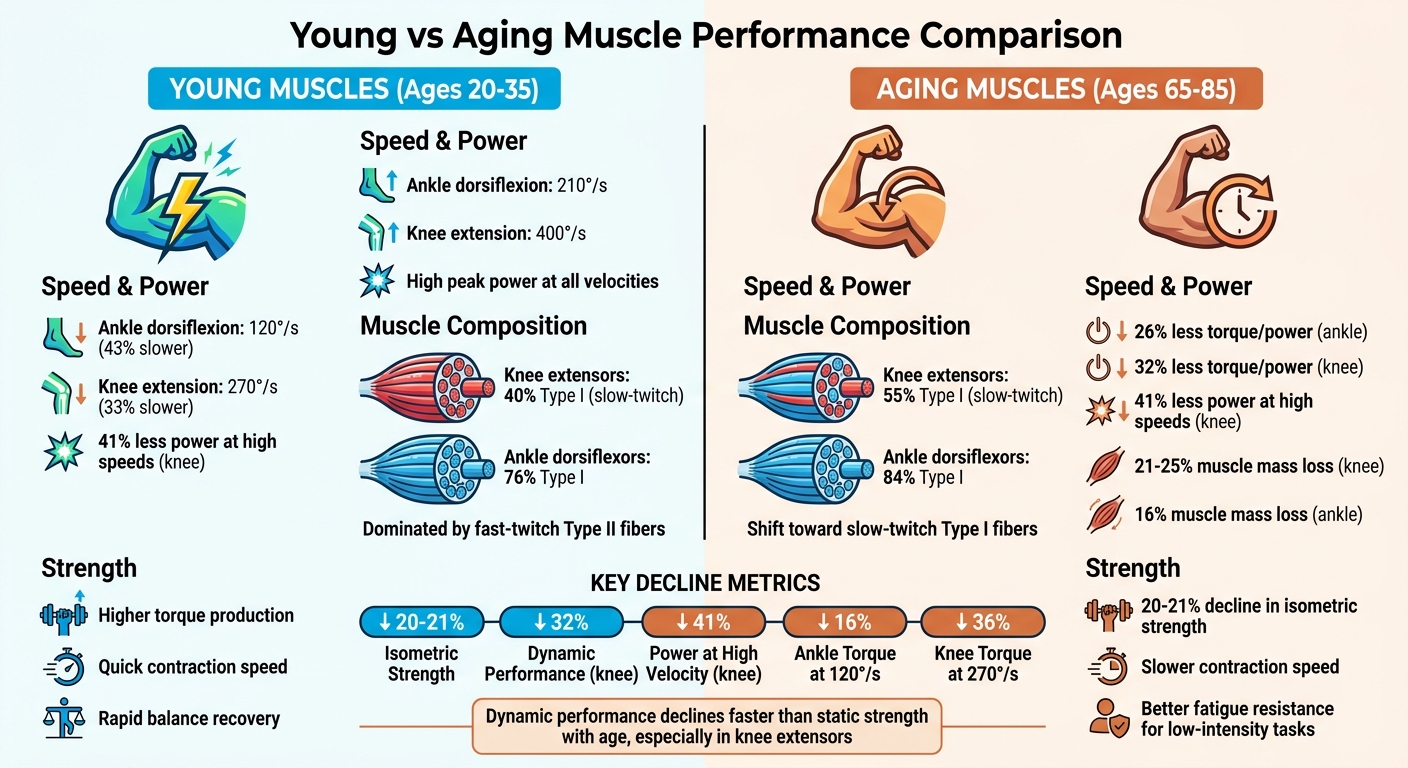
Young muscles excel at generating force across a range of speeds. A study conducted at the University of Massachusetts tested 12 young adults (average age 26) using a Biodex System 3 isokinetic dynamometer. The results showed impressive performance: participants were tested at preset velocities up to 210°/s in ankle dorsiflexion and 400°/s in knee extension. In comparison, older adults (average age 72) produced substantially less torque and power at the same preset velocities (e.g., 120°/s in ankle dorsiflexion and 270°/s in knee extension) than younger individuals.
This efficiency comes from key physiological advantages. Young muscles retain a higher percentage of their peak strength during rapid movements. They also reach target speeds much faster, enabling quick, explosive actions like sprinting or recovering balance. These abilities can be measured very reliably with isokinetic dynamometry, as repeated tests typically show very high test–retest reliability.
These performance differences are closely tied to muscle fiber composition, explored further below.
Muscle Group Variability
Muscle performance varies depending on the group and its role. For example, knee extensors often contain roughly 40–50% Type I (slow-twitch) fibers and the remainder as fast-twitch fibers optimized for powerful, high-intensity activities. On the other hand, ankle dorsiflexors are predominantly slow-twitch, with a predominance of Type I fibers in many studies. This composition matches their functions - knee extensors handle tasks like standing up or climbing stairs, while ankle dorsiflexors focus on balance and sustained movements.
Even with these differences, young adults demonstrate strong torque production in both muscle groups, regardless of speed. Interestingly, as angular velocity increases, the point in the range of motion where peak torque occurs shifts further along the joint's movement.
2. Aging Muscle Function
Force-Velocity Dynamics
As we age, the ability of our muscles to generate force and power at various speeds undergoes a noticeable decline. Research shows that older adults (average age 72) produce about 26% less torque and power in the ankle dorsiflexors and 32% less in the knee extensors compared to younger individuals. This isn't just about losing strength - it also involves slower movement capabilities.
The gap becomes even wider at higher speeds. For instance, at 270°/s, older adults generate 41% less power in their knee extensors. The Journal of Applied Physiology highlights this trend:
With age, the impairment of dynamic performance appears to exceed the loss of isometric performance, particularly in the knee extensor muscles.
Several factors drive these changes. Sarcopenia, or the loss of muscle mass, plays a major role, with some studies reporting roughly 20–25% smaller knee extensors and around 15% smaller ankle dorsiflexors in older adults. On top of that, fast-twitch Type II fibers - key for quick, explosive movements - atrophy more than slow-twitch Type I fibers. This shift tends to make muscles slower overall; for example, some studies report a higher proportion of Type I fibers in the knee extensors of older adults compared with younger adults, although the exact percentages vary. Add to this a decline in motor unit discharge rates, and the ability to activate muscles quickly is further compromised.
Muscle Group Variability
Not all muscle groups are affected equally. Knee extensors, which depend heavily on fast-twitch Type II fibers, show a sharper decline in power as movement speed increases. This trend isn't as pronounced in the ankle dorsiflexors. For example, at the highest speeds tested, older adults experienced a 16% reduction in relative torque in the ankle dorsiflexors (at 120°/s) compared to a 36% reduction in the knee extensors (at 270°/s).
This difference matters in everyday life. Knee extensors are crucial for high-demand activities like standing up or climbing stairs. In contrast, ankle dorsiflexors are engaged more consistently during walking - a repetitive activity that may help maintain their function over time.
Fatigue Resistance
One potential advantage of aging muscles is that, in some low-intensity or sustained tasks, they can show relatively good fatigue resistance, partly due to a higher proportion of slow-twitch fibers. The higher proportion of Type I fibers in older adults, for example a higher share in the ankle dorsiflexors than in younger individuals in some studies, makes these muscles better suited for sustained, moderate efforts. However, this advantage doesn't offset the overall loss in speed and power. In specific controlled tests of short, maximal efforts, some studies have found similar fatigue rates between older and younger adults, even though older adults produce lower absolute power; however, in other high-speed or repeated tasks, older adults can show greater fatigability. The primary challenge lies in their reduced capacity for quick, forceful movements.
How to Save Your Muscles From Aging
Pros and Cons
When comparing young and aging muscles, the differences are striking. Younger muscles clearly excel in speed and power, while older muscles may perform relatively better in some prolonged, low-intensity tasks, particularly those relying heavily on fatigue-resistant fibers. Here's a closer look at how they stack up:
| Feature | Young Muscles (20–35 yr) | Aging Muscles (65–85 yr) |
|---|---|---|
| Contraction Speed | Quickly reach target speeds, achieving high angular velocities (e.g., >400°/s in knee extensors). | Slower to reach target speeds, often unable to achieve high velocities (>120°/s in dorsiflexors; >270°/s in knee extensors). |
| Power Production | Higher peak power across all velocities, especially at high speeds. | Noticeable power reduction, with greater impairment at higher velocities in knee extensors. |
| Isometric Strength | Produces more torque across various joint angles. | Generates less torque overall. |
| Fiber Composition | Dominated by fast-twitch Type II fibers. | Loss of Type II fibers, with a shift toward more slow-twitch Type I fibers. |
| Fatigue Resistance | Limited endurance due to fewer fatigue-resistant fibers. | Greater endurance for sustained, low-intensity tasks thanks to a higher proportion of fatigue-resistant Type I fibers. |
| Functional Adaptability | Highly adaptable, allowing quick torque production for balance and recovery. | Reduced adaptability, with slower responses to balance disturbances, increasing fall risk. |
The table highlights a key trade-off: younger muscles are optimized for higher speed and dynamic performance, while aging muscles tend to shift toward slower, more fatigue‑resistant characteristics. This shift is partly related to changes in muscle fiber composition, along with other age‑related neural and muscular adaptations. With aging, there is a relative shift toward more slow‑contracting fibers and atrophy of fast‑contracting fibers, which supports low‑intensity activities but reduces the capacity for explosive movements like jumping or quickly regaining balance. This loss can make older adults more vulnerable to falls.
Interestingly, not all muscle groups age the same way. For example, some studies suggest that ankle dorsiflexors may show slightly smaller losses in dynamic torque and power than knee extensors, indicating that different muscle groups do not age in exactly the same way. Meanwhile, knee extensors tend to show larger age‑related losses in dynamic power, particularly at higher velocities, than some distal muscles such as the ankle dorsiflexors. This points to the need for targeted strategies to address the specific needs of different muscle groups.
Conclusion
As we age, our muscles undergo changes that significantly impact their performance. In comparative studies, older adults show roughly 20–30% lower isometric strength and around 30% lower dynamic torque and power in muscles like the knee extensors, with the power deficit becoming larger at higher contraction velocities. Beyond just losing strength, aging muscles also contract more slowly, making it harder to generate force quickly when needed.
These changes have clear implications for fitness and rehabilitation strategies. Programs that focus solely on static exercises may overlook the critical loss of dynamic capabilities. Prioritizing high-velocity movements and rapid force production can be important for improving functional performance and may help reduce fall risk when combined with other balance and strength training. Quick torque generation can often be the deciding factor between staying upright or suffering an injury.
The findings also highlight the importance of targeted muscle training. Knee extensors, in particular, are more susceptible to age-related declines than ankle dorsiflexors. Since these muscles play a key role in everyday tasks like climbing stairs or standing up from a chair - especially when the knee is near full extension - focused training is essential for maintaining independence.
Research shows that several weeks of resistance or dynamic exercise training in older adults can increase motor unit firing rates and improve strength, indicating that some neural aspects of age-related decline are reversible. This demonstrates that age-related muscle decline isn’t entirely unavoidable. By shifting the focus from just building strength to enhancing power and speed, rehabilitation programs can address the specific weaknesses that interfere with daily life.
Understanding the relationship between force and velocity in aging muscles helps inform strategies to reduce fall risk and support independence. Although aging muscles naturally shift toward slower, more fatigue-resistant fibers, intentional training focused on speed and power can help meet the dynamic demands of everyday activities.
For additional insights into muscle function and tailored training methods, check out the resources available at the Institute of Human Anatomy.
FAQs
Why does muscle power drop faster than strength with age?
Muscle power tends to decrease faster than muscle strength as we age. This is because power depends on a combination of force and velocity. With aging, muscle velocity diminishes significantly, which speeds up the decline in power more than in strength.
What exercises best improve speed and power in older adults?
Resistance training that emphasizes high-velocity movements can be an effective way to improve muscle power and functional performance in older adults, when appropriately prescribed and supervised. These types of exercises specifically target muscle power, which naturally diminishes as we age. Adding this kind of training to a regular workout routine can improve muscle performance and help maintain overall mobility.
Why do knee extensors weaken more than ankle dorsiflexors with age?
As people age, knee extensors tend to weaken more noticeably than ankle dorsiflexors. Studies comparing young and older adults suggest greater age-related reductions in the knee extensors’ torque and power, particularly at higher velocities. These changes are likely tied to peripheral impairments and the natural loss of muscle strength and power with age, which appear to impact knee extensors more significantly than ankle dorsiflexors.

