
Motor Unit Patterns: Size Principle in Exercise
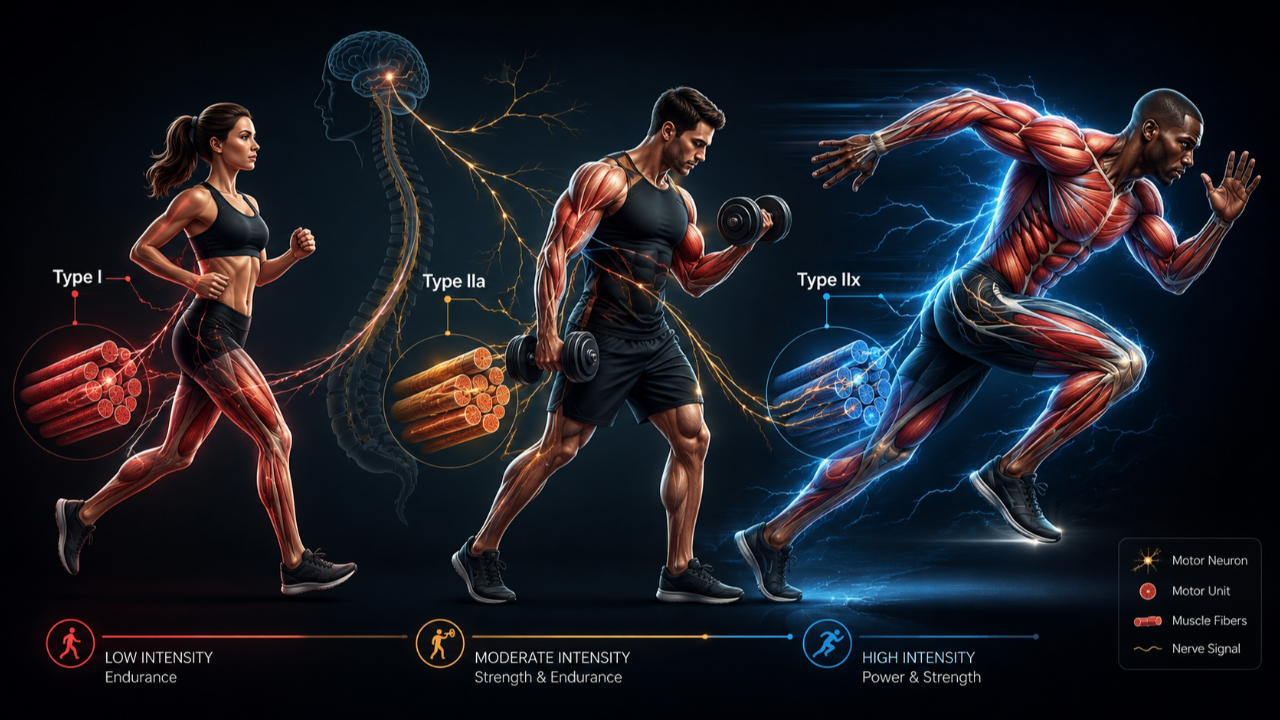
May 17, 2026Motor units are the building blocks of muscle movement, controlling how your body generates force during different activities. Here's what you need to know:
- Motor Units Explained: Each motor unit consists of a motor neuron and the muscle fibers it controls. You can learn human anatomy in-depth through interactive courses and labs. They work on an "all-or-none" basis - either all fibers contract, or none do.
- The Size Principle: Small motor units activate first for low-intensity tasks, while larger, more powerful motor units are recruited as intensity increases.
- Types of Motor Units:
- Type 1 (Slow-Twitch): Built for endurance; used in activities like walking or maintaining posture.
- Type 2a (Fast-Twitch): Balance strength and endurance; ideal for moderate-intensity tasks.
- Type 2x (Fast-Twitch): Produce explosive power; used for high-intensity exercises like sprinting or heavy lifting.
- Exercise Intensity: Low-intensity activities rely on Type 1 units, while high-intensity efforts recruit larger, fast-twitch units for maximum force.
- Training Insights:
- Strength training with heavy loads (80–95% of your max) activates high-threshold motor units.
- Endurance training emphasizes fatigue‑resistant fibers and often promotes shifts of fast‑twitch fibers toward more fatigue‑resistant profiles, rather than completely avoiding fast‑twitch units.
Understanding motor unit recruitment helps you tailor workouts for strength, power, or endurance. Whether you're lifting heavy or running long distances, your nervous system ensures efficient muscle activation.
Motor Unit Types and Their Characteristics
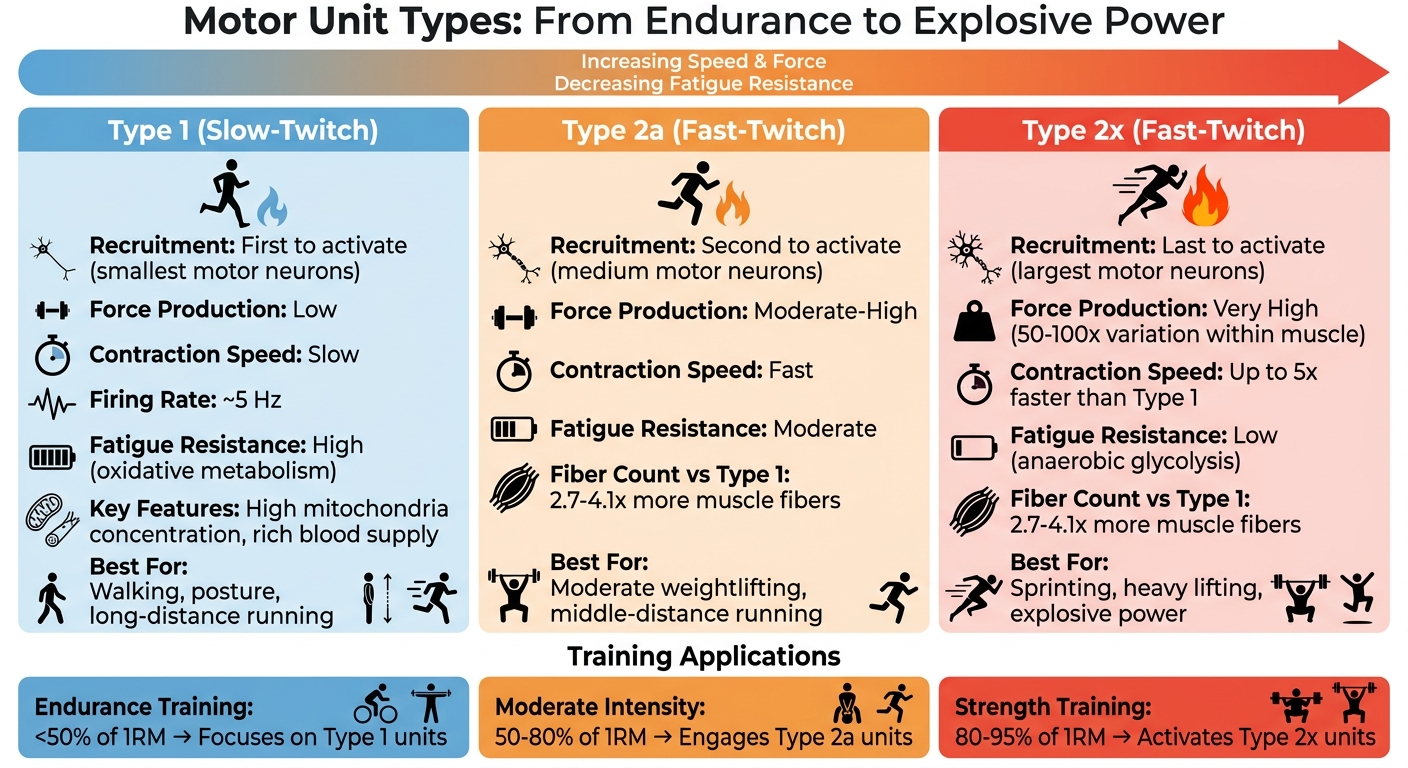
Motor Unit Types Comparison: Characteristics and Exercise Applications
Motor units play a key role in muscle function, with their fiber composition determining how much force they can produce, how quickly they contract, and how resistant they are to fatigue.
Type 1 (Slow-Twitch) Motor Units
Type 1 motor units are built for endurance. These are the first to be recruited during movement, thanks to their small motor neurons. They produce low levels of force but excel in fatigue resistance due to their oxidative metabolism, which relies on a high concentration of mitochondria and a rich blood supply. These features make them perfect for activities that require sustained effort, like maintaining posture, walking, or running long distances. Type I units fire steadily at relatively low rates compared with fast units, helping provide smooth, controlled contractions over long durations.
Type 2a and Type 2x (Fast-Twitch) Motor Units
For tasks requiring more power, fast-twitch motor units come into play. Type 2a motor units are the next in line to be recruited. They generate more force and contract faster than Type 1 units, while still offering decent fatigue resistance. This makes them ideal for activities that need both strength and endurance, such as moderate-intensity weightlifting or middle-distance running.
Type 2x motor units, on the other hand, are designed for explosive power. These are activated during high-intensity efforts like sprinting or heavy lifting. They innervate 2.7–4.1 times more muscle fibers than Type 1 units and can contract up to five times faster. This gives them the ability to produce massive force in a short time, though they fatigue quickly due to their reliance on anaerobic glycolysis. Interestingly, within a single muscle, maximal force among motor units can vary by tens of fold between the smallest and largest units.
This classification of motor units highlights how the body balances force production with fatigue resistance, adapting motor unit recruitment to match the intensity of the activity.
How Exercise Intensity Affects Motor Unit Recruitment
Exercise intensity plays a key role in determining how motor units are recruited, building on the size principle. This principle ensures that motor units are activated in an orderly fashion, starting with the smallest and progressing to the largest based on the size of the motor neuron cell body. Let’s break down how different levels of exercise intensity influence motor unit activation.
Low-Intensity Exercise
In activities requiring minimal force, like walking or maintaining posture, the body primarily relies on small motor neurons. These neurons activate fatigue-resistant Type I muscle fibers, which are excellent for conserving energy during everyday movements. This strategy helps preserve the more powerful but fatigue-prone Type 2x motor units for situations requiring greater force. In some muscles, firing rates change only modestly at low force levels, with more pronounced increases as contractions become stronger.
High-Intensity and Explosive Exercises
When the intensity ramps up, the recruitment of motor units changes significantly. In some small hand muscles, most motor units are recruited by around half of maximal force, whereas in many larger limb muscles additional units are still being recruited at higher intensities. At these higher intensities, the body relies more on increasing the firing frequency of motor units - a process known as temporal recruitment - especially as you approach maximum effort. This strategy allows for the production of explosive force when needed, but it also leads to quicker fatigue due to the lower endurance of fast-twitch fibers.
Applying the Size Principle to Training Programs
Motor unit recruitment plays a crucial role in designing effective exercise programs by aligning specific loads and intensities with targeted muscle groups. Using the size principle allows for precise activation of motor units, ensuring exercises fulfill their intended goals. To reliably activate the largest and most powerful Type IIx motor units, high-force demands are needed, commonly achieved with heavy loads (around ≥80% of MVC), or with lighter loads taken close to failure. Based on these recruitment patterns, here’s how you can tailor your training for either explosive strength or sustained endurance.
This is What Exercise Does to Your Muscles!
Training for Strength and Power
Developing maximum strength and explosive power hinges on recruiting high-threshold motor units, which generate the most force. These Type IIx motor units remain dormant during low-intensity efforts and only activate when force demands are high. That’s why heavy lifting, often using ~80–95% of your 1RM for low repetitions, is a very effective way to recruit high-threshold motor units early in the set.
In the early stages of training, beginners see rapid strength gains largely due to improved motor unit recruitment, even before muscle growth becomes evident. In the first weeks of training, a large portion of strength gains is due to neural adaptations, such as improved motor unit recruitment and firing patterns, before substantial muscle growth occurs. For instance, untrained individuals may not fully activate all available motor units during maximal efforts, whereas highly trained strength athletes can approach near‑complete activation. These neural improvements can produce substantial early strength gains, often on the order of tens of percent, before marked muscle growth is evident.
Focusing on explosive acceleration (trying to move the load as fast as possible) can enhance neural drive and favor recruitment of high‑threshold motor units, even when the external bar speed is slow. This concept is particularly effective for compound movements like squats, deadlifts, and presses, which involve multiple muscle groups and engage a large number of motor units simultaneously.
Endurance Training and Smaller Motor Units
While strength training prioritizes high-threshold motor units, endurance-focused programs emphasize the activation of fatigue-resistant fibers. Low-intensity, sustained activities like distance running or cycling rely on Type I motor units, which fire at relatively low, steady rates and can maintain activity for long durations without fatiguing.
Because the size principle reserves the easily fatigable Type IIx fibers for high-force tasks, training at lower intensities (below 50% of 1RM) usually recruits fewer of these powerful but fatigue-prone units unless the effort is carried close to failure. This approach optimizes efficiency by activating only the motor units needed for the task, conserving energy and delaying fatigue. For athletes aiming to boost aerobic capacity, sustained and appropriately progressed endurance training that repeatedly challenges fatigue-resistant fibers is effective, and higher-intensity sessions that recruit more fast-fatigable units can also contribute.
The key takeaway: intense, explosive exercises activate both low-threshold and high-threshold motor units, while moderate to low-intensity efforts predominantly involve lower-threshold units, with higher-threshold units added as effort and fatigue increase.
Current Research and Future Directions
Advances in high-density surface electromyography (HD-EMG) and sophisticated decomposition algorithms are transforming our understanding of motor unit recruitment. These tools can now identify large populations (often many dozens) of active motor units in a single muscle per participant, giving researchers a clearer picture of how the nervous system controls movement. A 2025 systematic review analyzed data from 262 studies, mapping motor unit discharge behavior across various human muscles. The findings revealed that neural control strategies vary significantly depending on the muscle in use, deepening our understanding of how the size principle governs dynamic muscle activation.
One intriguing discovery is the variation in muscle-specific discharge rates. For example, at force levels above 60% of maximal voluntary contraction (MVC), the tibialis anterior shows the highest mean discharge rates, while the soleus consistently has the lowest. This suggests that training programs might need to be tailored to these differences. Muscles with higher discharge rates, like the tibialis anterior, could benefit from different volume and intensity approaches compared to fatigue-resistant muscles such as the soleus.
Research into contraction speed is also shifting perspectives on explosive training. Faster contractions - those at 20% MVC per second or greater - are linked to higher discharge rates during both recruitment and derecruitment, as well as increased "common drive", or synchronization among motor units. As one study highlights:
"Motor unit behavior is modulated by contraction force and speed, with faster contractions eliciting higher discharge rates and common drive".
This underscores the importance of focusing on contraction speed, not just load, when training for explosive power.
Another area of practical application is cross-education adaptations in unilateral training. Research shows that eight weeks of training one limb can lower recruitment thresholds and boost net discharge rates in the untrained limb. This adaptation can increase maximal voluntary force in the untrained limb by 7% after four weeks and 10% after eight weeks, offering a useful strategy for maintaining strength during injury recovery.
Recent studies also reinforce the size principle. For instance:
"The control scheme of motor-unit recruitment remains invariant during fatigue at least in relatively large muscles performing submaximal isometric contractions".
Even when fatigue reduces recruitment thresholds by 23% to 73%, the nervous system compensates by recruiting higher-threshold motor units earlier, ensuring efficient force production despite fatigue. This adaptability highlights the resilience of the motor control system in maintaining performance.
Conclusion
Understanding how motor units are recruited can be a game-changer when it comes to improving your training approach. Your nervous system follows a consistent sequence, starting with fatigue-resistant Type I fibers and moving to high-threshold Type IIx fibers as intensity ramps up. This sequence explains why different training strategies lead to varying outcomes, whether you're aiming for endurance, strength, or power.
If you're looking to tap into high-threshold motor units - the ones with the most potential for growth - specific strategies are key. Using heavy loads (around 70–85% of your one-repetition maximum) s a reliable way to recruit these units early in the set, making this approach highly efficient for building strength. Alternatively, lifting lighter weights close to failure, leaving just 1–3 reps in reserve, can also push your nervous system to engage these powerful motor units. Adding an explosive effort to your lifts can further enhance recruitment.
It's worth noting that early strength gains are primarily due to neural adaptations, not muscle growth. During the first month of training, a large share of strength improvements is attributed to neural adaptations, such as more effective motor unit recruitment and firing behavior, before substantial muscle growth occurs. For perspective, highly trained strength athletes can approach near-complete activation of available motor units during maximal efforts, whereas untrained individuals often do not fully activate all motor units.
To put this knowledge into action, focus on compound exercises like squats and deadlifts. These movements target multiple muscle groups and allow for progressive overload, whether you're increasing the weight or the number of reps. Whether you're training for a marathon or preparing for a powerlifting competition, understanding motor unit recruitment can help you design more effective workouts.
For more insights on exercise physiology and the connection between anatomy and performance, check out the Institute of Human Anatomy blog.
FAQs
Do light weights to failure recruit the same motor units as heavy weights?
Lifting light weights to the point of failure can activate the same motor units as lifting heavy weights. This includes high-threshold motor units, which come into play as fatigue sets in and effort increases during low-force exercises performed to the point of volitional fatigue. Research backs up this phenomenon.
How do I train to recruit more high-threshold motor units faster?
To activate high-threshold motor units more quickly, you need to push your exercise intensity beyond the activation levels of larger, fast-twitch motor units. According to the size principle, motor units are engaged in order - starting with smaller ones and progressing to larger ones as the demand for force increases. Performing resistance exercises at moderate to high relative intensities and including explosive movements performed with high effort can help improve your ability to recruit these motor units faster over time.
Does fatigue change the order of motor unit recruitment?
No, fatigue does not change the order in which motor units are recruited. As per Henneman's size principle, motor units are always activated in the same sequence, even when muscles are fatigued. This principle ensures that smaller, more energy-efficient motor units are engaged first, with larger ones coming into play only as the demand increases.

