

How Fatigue Affects Neuromuscular Control in Fitness
Apr 20, 2026Fatigue doesn’t just make you feel tired - it disrupts how your brain and muscles work together, affecting performance and increasing injury risk. After intense workouts, your nervous system may take longer to recover than your muscles, causing slower reaction times, poor coordination, and form breakdown.
Key takeaways:
- Neuromuscular fatigue impacts both the brain (central fatigue) and muscles (peripheral fatigue).
- Heavy resistance and high‑intensity sessions can reduce maximal force and voluntary activation for 24–72 hours, and in some cases neuromuscular function may take up to ~72 hours to fully recover, depending on the exercise and the individual.
- Central fatigue affects brain signals, while peripheral fatigue comes from muscle fiber stress and byproducts.
- Poor coordination and balance under fatigue increase injury risks during complex movements.
How to manage it:
- Space heavy training sessions 48–72 hours apart to allow full recovery.
- Include neuromuscular exercises (e.g., balance drills, plyometrics) 2–3 times a week to maintain proper form under fatigue.
- Use tools like vertical jump tests or bar speed tracking to monitor fatigue levels.
- Prioritize 8–9 hours of sleep for neural recovery.
Understanding these effects and planning recovery-focused training can help you improve performance and reduce injury risks.
Train Smarter, Not Harder: Understanding Central Nervous System Fatigue | Mike Israetel
How Neuromuscular Fatigue Develops
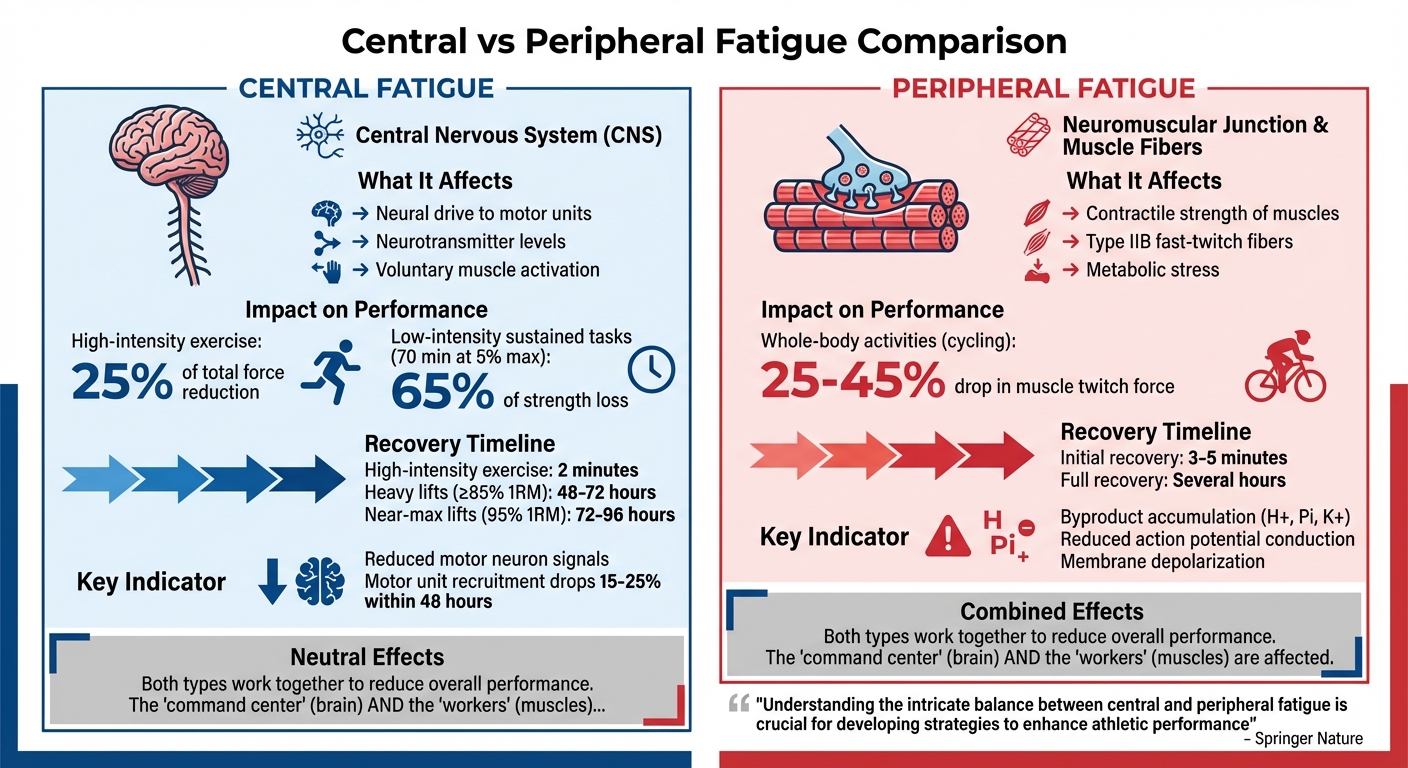
Central vs Peripheral Fatigue: Types, Effects, and Recovery Times
Neuromuscular fatigue involves two key processes happening in different parts of your body: central and peripheral. These processes explain why you might feel sluggish or weak, even if your muscles don't feel particularly sore. Let’s break them down to understand how they affect performance.
"Understanding the intricate balance between central and peripheral fatigue is crucial for developing strategies to enhance athletic performance, manage fatigue in clinical populations, and improve overall functional capacity." - Springer Nature
Central Fatigue: Reduced Neural Signals
Central fatigue originates in the central nervous system (CNS) - specifically the brain and spinal cord. Instead of affecting your muscles directly, this type of fatigue reduces the neural drive sent to motor units, leading to fewer motor neuron signals firing. Changes in neurotransmitter levels can also lower voluntary muscle activation.
In some sustained maximal efforts, central fatigue can account for a substantial proportion (around a quarter) of total force loss, and in certain long‑duration, low‑intensity tasks it may represent the majority of the strength reduction. After brief, high‑intensity efforts, the central component of fatigue often recovers largely within a few minutes, but longer or repeated bouts can leave central and peripheral fatigue that persist for many minutes to hours.
While central fatigue reduces the brain's ability to send signals, peripheral fatigue impacts the muscles themselves, creating a combined effect that hinders overall performance.
Peripheral Fatigue: Muscle Fiber Breakdown
Peripheral fatigue occurs directly at the neuromuscular junction and within the muscle fibers. It’s characterized by a decline in the contractile strength of the muscles due to metabolic stress.
"Peripheral fatigue indicates a decrease in the contractile strength of muscle fibers." - STEM Fellowship Journal
During intense exercise, your body relies on Type IIB muscle fibers, which are fast-twitch fibers. These fibers are powerful but tire quickly because they have low aerobic capacity. As they work, byproducts like hydrogen ions (H+) and inorganic phosphate (Pi) build up. This accumulation triggers sensory neurons (Group III and IV muscle afferents) that inhibit the motor cortex and slow down the conduction of action potentials in the muscle. Additionally, potassium (K+) buildup in the T-tubules after repeated muscle contractions increases membrane depolarization, further reducing muscle strength.
The effects of peripheral fatigue are noticeable after intense, whole-body activities like cycling, where muscle twitch force can drop by 25% to 45%. Recovery from peripheral fatigue, particularly related to excitation-contraction coupling, takes longer than central fatigue - initial recovery may occur within 3 to 5 minutes, but full recovery can take hours.
Effects of Fatigue on Neuromuscular Control
Fatigue doesn’t just make you feel physically drained - it disrupts the communication between your brain and muscles. This breakdown affects reaction times, balance, and coordination, which can significantly raise the risk of injuries during training.
Slower Response Time and Poor Coordination
When you're fatigued, your brain struggles to coordinate movements effectively. Studies show that maximal force and voluntary activation can remain depressed for 24–48 hours after intense exercise, indicating reduced neuromuscular drive even when you feel ‘recovered.' This means even when you're giving it your all, your responses are slower, and your coordination suffers.
"The 'command center' is tired, not just the 'workers' (muscles)." – FitnessRec
Intense physical activity alters key neurotransmitter systems (such as serotonin, dopamine, and noradrenaline), which can influence motivation, perceived effort, and motor control, contributing to central fatigue. On top of that, the brain’s glycogen stores - its primary energy source - become depleted during high-effort activities. This can lead to mental fog and reduced neural output. The result? Slower reaction times and movements that feel clumsy or "off." These coordination issues also throw off your balance, increasing the likelihood of injuries, especially during complex or technical exercises.
Balance Problems and Increased Injury Risk
Fatigue doesn’t just make you less coordinated - it also weakens your ability to maintain balance and proper form. For example, grip strength often fails before the target muscles are fully exhausted, which can lead to dropped weights or poor execution of movements. Reaction times also slow during sudden shifts in balance, making dynamic exercises particularly risky.
Other warning signs, like an elevated resting heart rate, indicate that your neuromuscular system is struggling. Add mental fatigue into the mix, and it becomes harder to focus on proper technique, further increasing the risk of injury during high-intensity or fast-paced workouts.
Strategies to Reduce Fatigue Effects
Training smarter can help you manage neuromuscular fatigue while still making progress. Your nervous system, just like your muscles, needs proper recovery time - sometimes even more.
Structured Training and Rest Periods
Even if your muscles feel ready to go, your nervous system might not be. Many athletes need around 48–72 hours to recover neuromuscular function after very heavy compound lifts, and some may require longer after extremely heavy or high‑volume sessions. Recovery time depends on load, volume, conditioning, and individual response.
"Your muscles may be ready to train before your nervous system is. Adequate rest between heavy sessions (48-72 hours) is critical for neural recovery, not just muscular recovery." – FitnessRec
Plan your training week by spacing out high-demand exercises by at least 2–3 days. Start each session with the most taxing movements, like heavy compound lifts, Olympic lifts, or sprints, when your focus and energy are at their peak. Follow these with moderate-demand accessory exercises and finish with lower-stress isolation or machine work. Every 3–6 weeks, include a deload week where you reduce both intensity and volume by 40–60% to clear systemic fatigue.
Incorporating neuromuscular exercises can further help you maintain performance under fatigue.
Neuromuscular Exercises and Balance Training
Neuromuscular training (NMT) is designed to help your body keep proper form, even when you're worn out. This type of training includes plyometrics, balance drills, agility exercises, and dynamic stabilization to fine-tune movement patterns through repetition. Neuromuscular training programmes can substantially reduce injury risk—meta‑analyses in team sports report up to ~60% fewer ACL injuries and ~30–40% fewer ankle sprains, with meaningful reductions in overall lower‑extremity injuries.
"By instilling appropriate mechanics through longitudinal repetition, the athlete is better able to perform complex athletic tasks safely while stressed or fatigued." – Paul M. Inclan, MD
Dedicate 10–15 minutes, 2–3 times a week, to exercises like Nordic hamstring curls, single-leg lunges, heel raises, or landing stabilization drills. While NMT is often used as a warm-up, performing these exercises at the end of your workout can train your body to maintain proper technique when you're most fatigued. Consistency is key - if you stop, the benefits will fade, so keep these exercises in your routine throughout your season.
Shocking Look Inside a Torn ACL (Cadaver Dissection Revealed)
Comparison of Fatigue Reduction Methods
Different approaches tackle fatigue in different ways. Long rest periods between heavy sessions restore neural function, while shorter work-to-rest ratios in circuit training help manage metabolic stress. For example, a 1:1 work-to-rest ratio using 30 seconds of work and 30 seconds of rest has been shown to allow higher repetition volumes (about 0.61–0.81 reps per second) compared with shorter intervals like 10 seconds (about 0.49–0.77 reps per second), even though all protocols produced similar levels of acute neuromuscular fatigue.
| Strategy | Primary Benefit | Best For | Recovery Timeline |
|---|---|---|---|
| Extended Rest (about 48–72+ hrs) | Allows neuromuscular function (force and voluntary activation) to recover after very demanding sessions | Strength and power athletes | 48–72+ hours between heavy sessions |
| 30:30 Circuit Ratio | Higher volume with better execution quality | General fitness and hypertrophy | Allows partial energy restoration between sets |
| Balance Training | Improves proprioception and postural stability | Injury prevention across all levels | 10–15 minutes, 2–3 times weekly |
| Strength and neuromuscular training (‘preconditioning’) | Improves muscle strength, dynamic stability, and capacity to absorb forces, helping reduce injury risk | Athletes in high-risk sports | Ongoing throughout the training cycle |
Use autoregulation to adjust your training based on real-time feedback like bar speed, grip strength, or resting heart rate. For example, if your warm-up weights feel unusually slow, consider dialing back the intensity or volume for that session. Don’t underestimate sleep. Aim for about 8–9 hours per night, as adequate sleep supports brain function, neuroplasticity, and overall recovery, which are important for neuromuscular performance.
Monitoring and Prevention Methods
Keeping tabs on neuromuscular fatigue is key to putting the right training and recovery plans into action. Simple tests can signal when your nervous system needs extra downtime, helping you sidestep injuries and unproductive workouts.
Testing Neuromuscular Response
Vertical jump tests are a go-to method for tracking neuromuscular fatigue. A review of 97 studies revealed that 82.5% of analyses relied on vertical jumps to assess fatigue. Among these, jump height was the most commonly measured variable (75.0%), followed by peak power (41.3%).
"Vertical jump tests... are favored for being cost-effective, quick, and minimally fatiguing." – Twist et al.
To use this method effectively, start by establishing a baseline when you're well-rested - ideally at the beginning of your training week. Then, retest 24–48 hours after intense sessions. One study found that countermovement jump (CMJ) height explained just over half of the variation in maximal sprint cycling power 24 hours after exercise, supporting its use as a practical fatigue marker. If your jump height drops significantly compared to your baseline, it’s a sign to dial back your training intensity or volume to allow for recovery.
Another tool, Velocity-Based Training (VBT), offers real-time feedback during workouts. In velocity‑based training, a reduction in bar speed of roughly 10–20% from your normal values is often used as a practical indicator that neuromuscular fatigue is accumulating and that load or volume may need to be adjusted. Universities like Louisiana State and Georgia have integrated AI-driven systems to monitor movement patterns and deliver instant performance data. This approach aligns with the training methods discussed earlier, allowing you to tweak workouts based on real-time fatigue levels.
Using Institute of Human Anatomy Resources

Understanding the "why" behind fatigue starts with learning how your nervous system and muscles interact. The Institute of Human Anatomy uses real human cadavers to demonstrate the structures involved in neuromuscular control - like motor neurons, muscle spindles, and neural pathways that activate during activities like lifting, jumping, or sprinting. Their interactive courses and visuals break down these concepts for athletes and fitness professionals.
Their digital study guides further enhance this knowledge with detailed visuals and cadaver-based explanations. Topics like central versus peripheral fatigue, motor unit recruitment, and proprioceptive feedback are made clearer through these resources. Whether you’re an athlete fine-tuning your recovery or a coach designing smarter training programs, these insights provide a strong anatomical foundation for managing neuromuscular fatigue. By linking the mechanics of fatigue to practical recovery methods, these tools ensure you're better equipped to handle the demands of training and recovery.
Conclusion
Neuromuscular fatigue affects both the central nervous system and muscle fibers, and intense training sessions can leave maximal force and voluntary activation measurably reduced for 24–72 hours, even when you feel recovered. Essentially, your brain might struggle to send strong activation signals to your muscles. This disconnect means that even if your muscles are physically ready, your nervous system might not be, resulting in slower reactions, poor coordination, and an increased risk of injury when recovery is overlooked.
Incorporating structured rest, using tools like vertical jump tests, and following well-designed training programs can help you train smarter. Neural and neuromuscular recovery after very heavy or exhaustive sessions can take 48–72 hours and, in some cases or individuals, closer to 96 hours. To stay on track, focus on getting 8–9 hours of sleep, plan a deload week every 3–6 weeks, and space out high-intensity workouts by 48–72 hours. These strategies highlight the importance of understanding how your body works for effective and safe training.
"Your muscles may be ready to train before your nervous system is." – FitnessRec
Gaining insight into the anatomy behind fatigue can lead to better training decisions. The Institute of Human Anatomy offers cadaver-based courses that break down these neuromuscular processes. Their interactive lessons and digital guides explain the role of motor neurons, muscle spindles, and neural pathways during training and recovery. By connecting what you experience during workouts to the underlying physiology, you can fine-tune your approach to training intensity and recovery for better results.
FAQs
How can I tell if my nervous system is still fatigued?
Signs that your nervous system might still be fatigued include reduced coordination, slower reaction times, or difficulty maintaining proper form during physical activity. If you notice these symptoms hanging around, it's a good idea to reach out to a healthcare professional for advice and support.
How should I adjust training if I’m lifting heavy multiple days a week?
If you're hitting the gym hard and lifting heavy multiple times a week, managing fatigue is key to staying on track. One way to do this is by tweaking your training volume or intensity on specific days. Also, steer clear of constantly pushing yourself to failure - it can take a toll over time.
Keep an eye out for signs of central nervous system (CNS) fatigue, such as feeling less motivated or noticing a drop in coordination. These are red flags that your body might need more recovery time. Prioritizing rest and recovery not only helps you avoid overtraining but also ensures you can keep making progress in the long run.
What are the best neuromuscular drills for preventing form breakdown?
The most effective neuromuscular drills for avoiding form breakdown are those that target force control and neural recovery. Some great methods include slow, deliberate reps that focus on precision, isometric holds to build stability, and proprioceptive exercises that sharpen body awareness and coordination. On top of that, managing central nervous system (CNS) fatigue with proper recovery techniques is crucial. This helps maintain neuromuscular coordination and lowers the chances of losing form during intense workouts.

