
Muscle Torque Decline with Age: Causes and Impact
May 27, 2026As we age, muscle torque - the rotational force muscles generate - declines, making everyday movements harder and increasing the risk of falls. This issue stems from muscle loss, slower contraction speeds, and changes in neuromuscular function, with dynamic strength deteriorating faster than static strength. For example, older adults produce 26% less torque in ankle muscles and 32% less in knee extensors compared to younger individuals.
Key takeaways:
- What declines: Muscle torque, especially in the lower body (e.g., quadriceps, ankle dorsiflexors).
- Why it matters: Reduced torque impacts balance, mobility, and increases fall risk.
- Causes: Muscle atrophy (sarcopenia), slower contraction speeds, and neuromuscular changes.
- Solutions: Resistance training to maintain strength, power training to improve speed, and proper nutrition to support muscle health.
Age-Related Muscle Torque Decline: Statistics and Impact on Daily Movement
The Problem: Muscle Torque Decreases with Age
What is Muscle Torque?
Muscle torque refers to the rotational force your muscles produce around a joint, enabling movement and maintaining stability. It’s what allows you to perform actions like extending your knee to walk or flexing your ankle to adjust your footing.
A key aspect of muscle torque is the rate of torque development (RTD) - how quickly your muscles can generate force. This is crucial for situations where speed matters, like catching yourself after tripping or stabilizing on uneven ground. The faster your muscles can produce torque, the better your chances of avoiding a fall or injury.
Grasping the importance of torque in movement helps explain why its decline with age is such a concern.
How Aging Reduces Muscle Torque
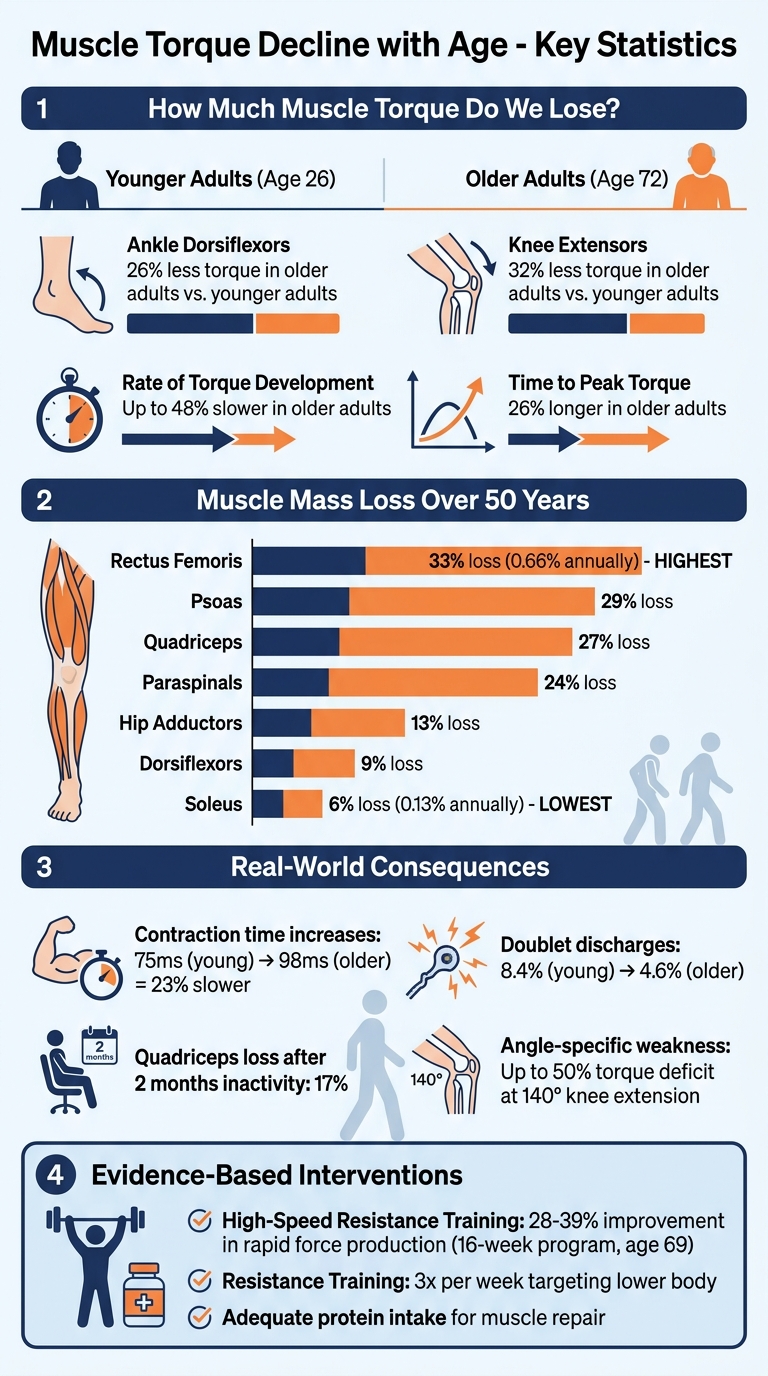
As people age, their ability to generate muscle torque diminishes significantly. Studies show that older adults (average age 72) produce about 26% less concentric torque in the ankle dorsiflexors and 32% less in the knee extensors compared to younger adults (average age 26). The knee extensors - primarily the quadriceps - are hit particularly hard, experiencing greater declines than smaller muscle groups like the ankle dorsiflexors.
This issue becomes even more pronounced because dynamic strength declines faster than static strength. In other words, the ability to generate force during movement deteriorates more quickly than the ability to hold a steady force. For older individuals, the maximal rate of torque development has been reported to be about 48% lower in some studies, and it takes about 26% longer to reach peak torque. This slower reaction time can be critical in situations requiring quick responses.
The result? A growing gap between the physical demands of daily life and the body’s ability to meet them. Everyday tasks like climbing stairs, standing up from a chair, or recovering balance after a stumble all rely on rapid torque production - precisely the function that weakens most with age. This decline directly undermines mobility, balance, and overall safety.
Main Causes of Muscle Torque Decline
Loss of Muscle Mass (Sarcopenia)
Sarcopenia, the age-related loss of muscle mass, becomes more prominent after about midlife, especially in lower-body muscles, and is a major contributor to reduced torque, alongside neural and qualitative changes in muscle. This isn't just about shrinking muscles - it's also tied to the death of spinal motor neurons and the loss of their axons, which ultimately reduces the number of muscle fibers. The fibers that remain often function less effectively. Type II fast-twitch fibers, crucial for powerful movements like jumping or quickly regaining balance, are particularly vulnerable. Over five decades, the quadriceps may lose on the order of 20–30% of their volume in some longitudinal studies. Specifically, some imaging studies report small but cumulative annual losses in quadriceps muscles such as the rectus femoris, with slower declines in muscles like the soleus, though exact percentages vary by population and method. As motor neurons die, surviving neurons attempt to "rescue" muscle fibers through collateral sprouting, creating fewer but larger motor units. This adaptation compromises fine motor control, which is thought to contribute to slower and less precise muscle responses.
Slower Muscle Contraction Speed
Even when muscle fibers remain intact, the speed of contraction slows with age, further hindering torque production. This slowdown is critical for rapid movements, such as those needed to maintain balance. For instance, studies show that contraction times in some muscles are longer in older adults than in younger adults, reflecting a slowing of muscle contractile properties, although the exact values differ across studies. Additionally, the discharge frequency of motor units declines, delaying muscle activation. Quick bursts of force, known as doublet discharges, are also less common in older adults, being observed in a smaller proportion of motor units in older adults than in younger adults in some studies. These factors collectively reduce the muscles' ability to generate force quickly.
Neuromuscular and Biomechanical Changes
Aging also brings changes to neuromuscular communication and joint mechanics, further limiting torque. The neuromuscular junction becomes less stable, with greater variability in electrical signaling. This instability weakens the transmission of signals to muscle fibers, reducing their efficiency. Biomechanical changes are also joint-specific. For example, in knee extensors, torque deficits are relatively minor at a 90° bend but can be substantially greater at more extended joint angles in some studies. These changes not only reduce maximum force but also limit the effective range of motion. This narrowing of functional movement, combined with weaker neural signals and slower muscle contractions, makes it harder to perform quick, dynamic actions required for everyday tasks.
How Muscle Torque Decline Affects Movement and Daily Life
Effects on Mobility and Daily Tasks
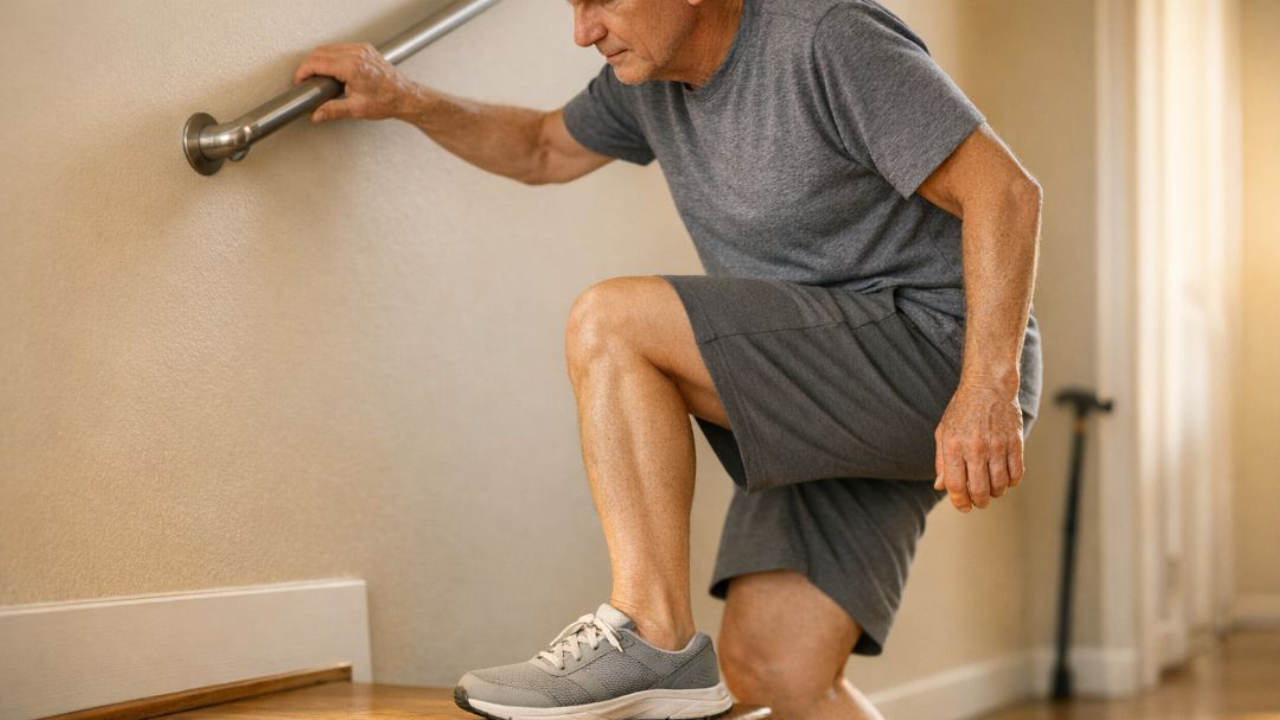
A drop in muscle torque directly impacts everyday movements, making common tasks harder to perform. Research highlights that reduced muscle torque significantly affects vertical movements like standing up from a chair, climbing stairs, or stepping down. These challenges stem from both muscle deterioration and changes in neural function.
One striking example is angle-specific weakness. An older adult might retain decent strength at a 90° knee bend (like when seated) but experience pronounced weakness at 140° of extension - the angle crucial for climbing stairs. Compounding this, the rectus femoris, a key muscle in the thigh, loses about 0.66% of its mass annually. This steady decline not only makes daily tasks harder but also increases instability during movement.
Higher Risk of Falls and Injuries
Reduced torque doesn’t just make movement harder - it also makes it less stable and predictable. Aging leads to greater variability in torque production, reducing the body's ability to quickly regain balance after a stumble or trip.
"Rapid torque production is required to maintain balance after a postural disturbance." – Journal of Applied Physiology
Slower torque development means slower recovery from balance disturbances. On top of that, dynamic power - a combination of torque and movement speed - declines faster than static strength. For instance, some studies show that older adults produce substantially less torque at higher dorsiflexor velocities (e.g., ≥120° per second), which may limit how quickly they can react to hazards like uneven ground.
Certain muscle groups are particularly affected, increasing the risk of falls. THip adductor and abductor weakness are associated with poorer lateral stability and greater fall risk, particularly for sideways falls that can lead to hip fractures, although specific long-term percentage losses vary across studies.. Meanwhile, weakening quadriceps in older adults can compromise knee stability and may alter how different muscle groups, including the hamstrings, contribute to maintaining posture and balance. If these muscle groups fail to coordinate properly, the likelihood of falls rises. This instability not only increases fall risk but also places added strain on joints.
Effects on Joint Health and Pain
The long-term decline in torque is associated with reduced stability and functional capacity, which can contribute to problems such as discomfort and impaired control around joints, especially in the lower back and knees. As muscles like the psoas and paraspinal muscles shrink, the lower back becomes more prone to instability.
In the knees, imbalanced torque amplifies joint stress, particularly during extended movements. This is especially problematic when descending stairs, as reduced control can make the activity both painful and difficult. To compensate for reduced stability, older adults often rely on increased cortical activity to "stiffen" their joints for balance. While this might provide short-term support, it can lead to inefficient muscle activation during precise tasks, further straining the joints. Over time, this compensation strategy not only increases discomfort but also exacerbates joint stress, emphasizing the need for targeted interventions to address these issues.
How to Save Your Muscles From Aging
What Cadaver Studies Reveal About Age-Related Changes
Cadaver studies provide essential anatomical insights that expand our understanding of how aging impacts muscle tissue. Unlike imaging techniques, these studies allow for the detailed examination of deep muscles - such as the psoas major and paraspinals - that are often inaccessible through biopsies. One key takeaway? Muscle atrophy doesn’t happen evenly across the body. Instead, it varies significantly between different muscles.
For example, research shows a striking range in atrophy rates. Over a 50-year span, the soleus muscle loses just 6% of its mass (about 0.13% annually), while the rectus femoris shrinks by 33% in the same period (0.66% annually). What drives this difference? It comes down to fiber type composition. Muscles rich in Type I (slow-twitch) fibers, like the soleus with 81% Type I fibers, are far more resistant to atrophy. In contrast, muscles dominated by Type II (fast-twitch) fibers, such as the rectus femoris with 62% Type II fibers, experience much steeper declines.
These studies also shed light on specific patterns of muscle loss. For instance, over 50 years, the psoas loses 29% of its mass, the quadriceps 27%, and the paraspinals 24%. Meanwhile, the dorsiflexors fare better, losing only 9%. This uneven decline explains why certain activities - like climbing stairs or standing up from a chair - become increasingly difficult with age. The muscles most critical for these movements are among those that deteriorate the fastest.
The Institute of Human Anatomy uses real cadaver specimens to make these findings accessible. Their courses and videos allow students and professionals to see firsthand how age-related changes manifest in muscle tissue, connecting research to practical application.
Understanding these muscle-specific atrophy patterns is key to creating effective interventions. By identifying which muscles are most vulnerable, we can develop targeted training and rehabilitation strategies to slow the decline in muscle torque.
How to Slow or Reverse Torque Decline
Age-related muscle decline doesn't have to be inevitable. With the right approach, it's possible to slow - or even reverse - torque loss. Research highlights that targeted training strategies can help older adults maintain and even improve muscle torque by focusing on both strength and speed. These methods directly tackle the underlying mechanisms of decline.
Resistance Training to Maintain Strength
Resistance training is key to preserving muscle mass. Prioritizing major lower-body muscle groups, especially the quadriceps and calf muscles, is crucial. These muscles play a vital role in daily activities like climbing stairs or standing up from a chair. A solid strength program should include exercises like squats, leg presses, leg extensions, and calf raises. Aim for three sessions per week to see results.
Consistency is non-negotiable - even a few weeks to months of marked inactivity can lead to substantial quadriceps atrophy, with some studies reporting losses approaching 10% within the first month. Staying active is the best way to keep your muscles strong.
Power Training for Speed-Specific Improvements
Maintaining speed is just as important as building strength, and that's where High-Speed Resistance Training (HSRT) comes in. This approach focuses on rapid force production, which is essential for balance and fall prevention, especially as we age.
A 16-week HSRT program involving older adults (average age 69) showed impressive results. Participants performed explosive squats and leg presses, leading to substantial improvements in rapid force production in the trained muscles. Even better, those who stayed moderately to vigorously active after the program kept nearly all their gains a year later.
Nutrition and Joint Health Strategies
Exercise alone isn't enough - nutrition plays a big role in muscle health. Adequate protein intake is crucial for muscle repair and maintenance. Pair this with joint-focused exercises to preserve mobility, reduce pain, and maintain range of motion. Together, these strategies not only protect muscle function but also support joint health, helping ensure long-term mobility and independence.
Conclusion
As we age, the decline in muscle torque becomes a reality for many, driven by factors like sarcopenia, slower muscle contractions, and changes in neuromuscular function. This process doesn’t affect all muscles equally - key muscle groups experience uneven atrophy, making dynamic movements and maintaining balance more challenging.
Research shows that older adults generate about 26% less torque in their ankle muscles and 32% less in their knee extensors compared to younger individuals. These losses aren’t just numbers - they directly impact daily activities and increase the risk of falls. Recognizing these issues is the first step toward finding solutions.
The good news? You can take steps to combat these changes. Resistance training helps maintain muscle mass, while high-speed power training focuses on improving your ability to produce force quickly. Pair these with a diet rich in protein to support muscle repair and growth, and you have a clear path to addressing the causes of torque loss and improving your quality of life.
"Early action can help you stay mobile, confident and in control of your health." - Cleveland Clinic
For a deeper understanding of how anatomical changes contribute to torque decline, check out the resources offered by the Institute of Human Anatomy. Their cadaver-based courses and videos provide practical knowledge to help guide your training and health decisions.
FAQs
How can I tell if my torque is declining?
Signs of decreasing torque often show up as weakened muscle strength during physical effort, a slower maximum discharge rate of motor units during quick movements, or a reduced ability to build torque quickly. These shifts are typical markers of the natural decline in muscle function that comes with aging.
What’s the fastest way to improve rate of torque development?
High-speed resistance training is the quickest way to boost the rate of torque development. Research shows that this approach delivers lasting benefits, especially for older adults, by improving muscle performance and increasing strength over time.
Which muscles should older adults train first to prevent falls?
Older adults should prioritize strengthening their lower body stabilizer muscles, especially the hip abductors and adductors. These muscles often experience greater weakening with age compared to knee extensors, making them essential for maintaining balance and lowering the risk of falls.

