
Effects of Agility Training on Athletic Performance
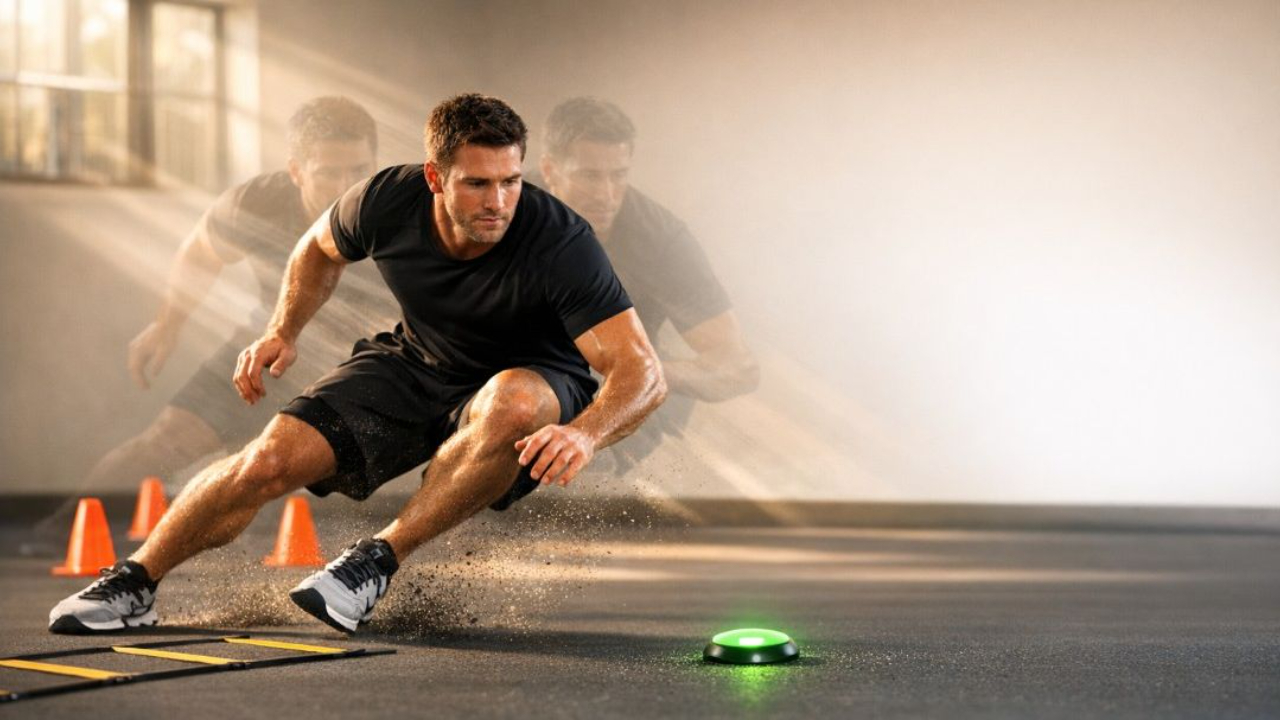
Jun 29, 2026Agility training improves athletic performance by enhancing quick direction changes, reaction times, and overall movement efficiency. It’s especially critical in sports like soccer, basketball, and football, where split-second decisions and explosive actions often determine outcomes.
Key insights from research:
- Two Types of Agility: Pre-planned drills mainly improve Change of Direction Speed (CODS), while reactive drills add perceptual and decision-making demands that are more similar to real-game agility.
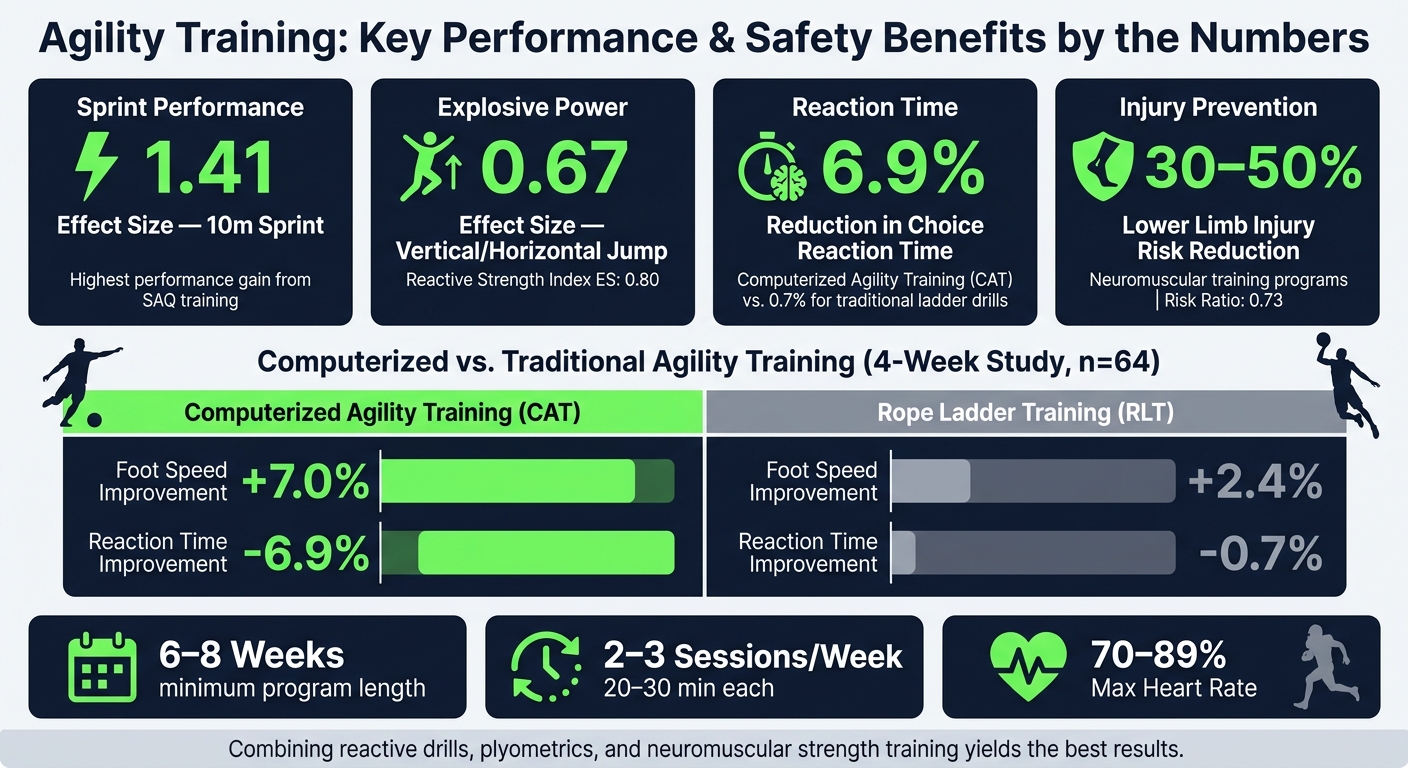
- Performance Gains: Speed, agility, and quickness (SAQ) training improves short sprints (10 m sprint pooled effect size around 1.0 in soccer players) and explosive power (vertical jump effect size: 0.67).
- Neuromuscular Benefits: Training sharpens brain-body coordination, can reduce reaction time and improve neuromuscular coordination, and improves balance.
- Injury Prevention: Multi-component neuromuscular programs that include agility exercises lower lower-limb injury risks by 30%-50% through better body control and joint strength.
Agility drills, like reactive runs and plyometric exercises, should last 20–30 minutes per session, 2–3 times a week for at least six weeks. Tailored programs combining reactive, strength, and plyometric exercises yield the best results.
Agility Training: Key Performance & Safety Benefits by the Numbers
Research Findings on the Benefits of Agility Training
Speed and Power Gains
Speed, agility, and quickness (SAQ) training has been shown to moderately improve sprint performance, with an effect size (ES) of 0.75 in soccer players. These improvements are especially noticeable in short sprints, such as 10-meter distances, which often show larger effects (with pooled ES around 1.0 in soccer players). Beyond speed, SAQ training enhances explosive power, as evidenced by improvements in vertical and horizontal jump performance (ES = 0.67) and improvements in measures of reactive strength such as the Reactive Strength Index.
"SAQ training effectively enhances speed, COD, explosiveness, and change-of-direction dribbling specific performance in adolescent soccer players, particularly in sprinting." - Sun M, Soh KG, Ma S, Wang X, Zhang J, Yaacob AB
These performance gains are largely attributed to neuromuscular adaptations, which also improve balance and reaction efficiency.
Neuromuscular Coordination and Balance
Agility training goes beyond boosting speed; it fine-tunes the connection between the brain and body during high-stress movements. A key factor here is improved perception–action coupling, which refers to the ability to quickly interpret external cues and respond appropriately.
A 2025 randomized controlled trial from Dalian University compared Computerized Agility Training (CAT) - using randomized visual stimuli - with traditional Rope Ladder Training (RLT) in 64 male collegiate basketball players over four weeks. Results showed that the CAT group improved foot speed by 7.0% and reduced choice reaction time by 6.9%. In contrast, the RLT group saw smaller gains, with foot speed increasing by 2.4% and reaction time improving by just 0.7%.
"Computerized agility training significantly enhanced reactive agility and basketball-specific skill execution beyond rope ladder training, particularly in tasks involving perception and decision-making." - Xiao Xu, College of Physical Education, Dalian University
Unlike traditional ladder drills, which emphasize rhythmic footwork, CAT mimics real-game scenarios by requiring athletes to process stimuli and react quickly. These neuromuscular improvements not only enhance performance but also play a crucial role in injury prevention and efficient movement.
Injury Prevention and Movement Efficiency
Agility training is a key component in reducing injuries and improving movement efficiency, both of which are essential for maintaining peak performance. Neuromuscular training programs that include agility exercises have been shown to lower the risk of lower limb injuries by 30% to 50%. Enhanced body control during deceleration - a critical phase in sprints or directional changes - helps minimize non-contact injuries.
Integrative Neuromuscular Training (INT), which combines strength, plyometrics, and agility, has proven effective in reducing injury risk and reducing lower limb injury risk while improving dynamic balance (with small-to-moderate standardized effects in meta-analyses). Additionally, neuromuscular warm-ups have been shown to enhance change-of-direction performance (g = 0.46) and increase knee isokinetic strength (g = 0.72).
"Neuromuscular warm-up holds significant clinical value for enhancing athletic performance and reducing injury risk." - Frontiers in Physiology
Agility training also addresses laterality effects - the tendency for athletes to favor one turning direction over another. By focusing on the weaker side through targeted drills, athletes can achieve more symmetrical movement patterns. This balance reduces mechanical stress and lowers the risk of injury over time.
Strength vs Hypertrophy: The Science of How to Build Muscle
Neuromuscular Adaptations and the Role of Anatomy
Anatomical Structures Involved in Agility
To fully benefit from agility training, it's essential to understand the anatomical mechanics behind movements like cutting, sprinting, landing, and quick direction changes. These actions rely heavily on the ankle, knee, and hip joints, each serving a unique purpose. The ankle is crucial for generating rapid force during push-off. The knee, supported by the hamstrings and quadriceps working together, ensures stability under high-speed conditions. Meanwhile, the hip provides the power and rotational force necessary for quick body reorientation.
But agility isn’t just about the lower body. Trunk positioning plays a bigger role than many athletes realize. The angle of the torso and the height of the center of mass directly impact balance during fast, directional shifts. Even slight adjustments in trunk alignment can significantly enhance stability.
How Neuromuscular Changes Drive Performance Gains
Agility training does more than build muscle - it sharpens the nervous system to improve movement speed and coordination. Two primary mechanisms contribute to these gains: improved stretch-shortening cycle (SSC) efficiency and enhanced neural drive. The SSC, which functions like a spring during rapid muscle stretches and contractions (think jumping or cutting), becomes more efficient with training. At the same time, the nervous system sends faster and stronger signals, enabling quicker muscle activation and better overall coordination.
"The accompanying neurophysiological adaptations [of SAQ training] are associated with enhanced efficiency around the stretch-shortening cycle (SSC)." - Sun et al., PLOS One
Another critical factor is eccentric knee flexor strength, which allows the hamstrings to resist lengthening under load. This strength is essential for safe deceleration during cutting movements. Research suggests that combining plyometric exercises, dynamic stability work, and eccentric strengthening creates the most comprehensive results.
How Your Muscle Fibers Change With Exercise
How Cadaver-Based Anatomy Education Supports Agility Training
Understanding the "why" behind these structures is just as important as training them. For instance, knowing that the hamstrings control knee deceleration or that strong hip abductors stabilize lateral movements transforms anatomy knowledge into a practical tool for performance.
The Institute of Human Anatomy provides cadaver-based anatomy education that brings these concepts to life. Seeing the intricate design of the knee joint, the layers of hip muscles, or the paths of critical nerves in the lower limbs offers a deeper understanding of movement mechanics. This knowledge helps in selecting smarter exercises and designing programs that not only improve performance but also reduce injury risks.
This is What Exercise Does to Your Muscles!
Practical Guidelines for Agility Training Programs
These guidelines translate neuromuscular research into actionable steps to improve agility while reducing the risk of injury. By focusing on neuromuscular adaptations, you can create structured and effective agility training programs.
Training Duration and Frequency
To see meaningful results, agility programs are commonly implemented for 4–12 weeks, with two to three sessions per week, each lasting 20–30 minutes. Higher-intensity sessions performed regularly have been associated with significant agility improvements, although specific heart-rate targets are not consistently reported across studies. Extending the program to eight weeks can yield even better outcomes.
A practical example comes from elite soccer players at Stade Rennais Football Club, where replacing standard warm-ups with a neuromuscular protocol - two 30-minute sessions per week over six weeks - led to faster turning speeds in both directions without increasing overall training volume.
"Practitioners are advised to focus their training programs on both turning directions" to reduce laterality effects in athletes. - Hassane Zouhal, Professor of Sport Science, University of Rennes
Core Agility Drills and Exercises
Reactive drills can provide additional benefits for reactive-agility tasks compared with purely pre-planned exercises, especially when the goal is to mimic real-game decision-making. Research highlights that reactive drills enhance reactive-agility performance and decision-making in sport-specific tasks more than traditional pre-planned drills.
Below is a breakdown of key training components, with examples and their specific targets:
| Training Component | Example Drills | Target Metric |
|---|---|---|
| Reactive Agility | Random Star Run, LED Pod Tapping | Reaction Time (s) |
| Change of Direction | T-Test, Illinois Agility Test | Completion Time (s) |
| Plyometrics | Drop Jumps, Box Jumps | Ground Contact Time (aim to approach ≤0.174 s; benchmark from one study, not a strict requirement) |
| Neuromuscular Strength | Nordic Hamstring Curls, Eccentric Squats | Eccentric Torque (higher hamstring torque is beneficial; ≥2.5 Nm/kg was a high-performance benchmark in one study) |
For a well-rounded program, include at least three of these components. Start with simple bi-directional drills and gradually progress to multi-directional tasks involving six or more stimuli to enhance skill transfer. For plyometric exercises, a moderate volume of foot contacts per session (for example, on the order of a few dozen) while prioritizing proper landing techniques. These variations allow for customization based on the needs of different athletes.
Adjusting Programs for Different Populations
Agility training should align with the athlete's sport, age, and experience level. For team sport athletes, like basketball or soccer players, incorporating reaction training through small-sided games (such as 2v2 formats) can be highly beneficial.
For military personnel or other athletic populations, an Integrated Neuromuscular Training (INT) approach works well. For instance, an eight-week INT program led to a 1.15-second improvement in Illinois Agility Test times among military cadets, while traditional training showed no significant benefits after four weeks.
Tailor the complexity of drills to the athlete’s skill level. Beginners may benefit from simple, cue-based exercises, while advanced athletes often require more cognitively demanding drills with faster decision-making and multiple stimuli.
Key Takeaways on Agility Training
Agility training leads to noticeable improvements in athletic performance. Studies show measurable gains in sprint speed, power, and short-distance acceleration, with the most significant boost seen in short-distance acceleration - with meta-analyses reporting moderate improvements in 10-meter sprint performance.
These performance gains are largely driven by neuromuscular adaptations. By refining muscle coordination, these adaptations enhance how efficiently the body moves.
"Optimization of lower body explosiveness is considered crucial for enhancing sprinting, and this optimization depends not only on muscular strength but also involves improved coordination between the nervous system and muscles." - PLoS One
In addition to improving performance, agility training contributes to athlete safety. Integrative Neuromuscular Training (INT) has been shown to reduce injury risk (risk ratio 0.73) by improving body control and proprioception. Understanding the role of key anatomical structures - like the hamstrings, hip flexors, and sensory pathways responsible for perception-action coupling - enables coaches to create programs that are both effective and safe.
The most effective agility programs combine a variety of training methods. Reactive drills sharpen cognitive agility, plyometric exercises build explosive power, and strength training fortifies the joints that handle braking forces. Tailoring these elements to match an athlete's sport and experience ensures the best results while minimizing injury risks.
FAQs
Should I do reactive agility drills or pre-planned drills first?
Research indicates that pre-planned agility and neuromuscular drills are effective for developing the mechanical basics of movement, such as strength, power, and proper technique. Once these fundamentals are in place, incorporating reactive agility drills can sharpen decision-making skills and simulate real game situations more effectively. Begin with pre-planned drills to build a strong foundation, then transition to reactive drills for a more well-rounded approach to performance. The Institute of Human Anatomy provides insights into how neuromuscular systems contribute to these movements.
How do I measure real progress in agility training?
To monitor progress in agility training, it's helpful to use standardized tests that assess both physical and cognitive improvements. Some key metrics to focus on include linear sprint speeds over distances like 5, 20, or 30 meters, change-of-direction (COD) performance, and reactive agility tests (RAT), which measure responses to visual cues. Additionally, tracking reaction times or benchmarks such as a vertical jump can provide valuable insights into overall development. For a deeper understanding of the mechanics behind these movements, resources from the Institute of Human Anatomy can be a great help.
What’s the safest way to add agility work without increasing injury risk?
To incorporate agility work safely, focus on progressive training. Begin with controlled drills to master proper technique, and then gradually move on to more reactive and high-intensity exercises as your skills improve. Incorporating neuromuscular training - such as activities that enhance dynamic stability, balance, core strength, and plyometrics - can help refine biomechanics and lower the risk of injury. For optimal safety and performance, avoid excessive fatigue by keeping agility-focused blocks relatively short (for example, around 20–30 minutes) and allowing adequate recovery. If you're looking to deepen your knowledge of the neuromuscular systems at play, the Institute of Human Anatomy offers helpful resources.

