

Muscle-Tendon Mechanics for Locomotion
Jun 24, 2026Every step you take relies on the teamwork between muscles and tendons. Muscles generate force, and tendons store and release energy, making movements like walking, running, and jumping efficient. Here's what you need to know:
- Muscle-Tendon Unit (MTU): Combines muscle fibers and tendons to transfer force and enable movement. Tendons act like springs, storing elastic energy during stretching and releasing it during recoil.
- Efficiency in Movement: Tendons can contribute a substantial portion of the mechanical work of the muscle tendon unit during locomotion, helping to reduce the metabolic cost of movement. For example, the Achilles tendon can meaningfully reduce the energy cost of running by recycling elastic energy, though the exact percentage depends on speed, individual anatomy, and measurement methods.
- Structural Differences: Human Achilles tendons are substantially longer than in chimpanzees, which is thought to contribute to economical upright walking and distance running in humans.
- Stretch-Shortening Cycle (SSC): Tendons store energy during muscle lengthening and release it during shortening, reducing muscle work and and can contribute, together with muscle mechanisms, to higher power output.
- Training and Aging Effects: Resistance training generally increases muscle strength and can increase tendon stiffness, whereas aging and reduced physical activity are associated with declines in muscle performance and, in many cases, lower tendon stiffness.
Understanding this interaction helps improve performance, reduce energy use, and address injuries. Whether you're walking, running, or training, the MTU is key to efficient movement.
Calf Strains, Tendinitis, & Achilles Tears | The Anatomy of the Calves
Structural and Mechanical Properties of Muscles and Tendons
The structural and mechanical properties of the muscle-tendon unit (MTU) play a crucial role in optimizing movement dynamics and energy efficiency. Understanding these systems often requires a deep dive into human anatomy.
Key Structural Features of Muscles
The architecture of muscles directly influences how they perform during movement. Two key factors - fascicle length and pennation angle - work together to determine force and velocity output. Longer fascicles allow for greater shortening velocity, while a higher pennation angle accommodates more muscle fibers within a given cross-sectional area, increasing force production. However, this comes with a trade-off. Shorter fibers are more energy-efficient because they contain fewer sarcomeres in series, but they must still be long enough to handle the velocities required for mechanical work.
A study by Lichtwark and Wilson (2008) highlighted how walking and running demand different muscle architectures. Efficient walking is associated with relatively shorter fascicles (on the order of ~45–55 mm in the gastrocnemius) and more compliant tendons in some models, while running at higher speeds is associated with relatively longer fascicles (up to ~70 mm in those models) and functionally stiffer tendons to manage higher forces and speeds to manage higher forces and speeds. These structural features help set the stage for how tendons behave under various loads.
Tendon Mechanics and Elasticity
Tendons, which are viscoelastic in nature, can act as springs or shock absorbers depending on how quickly they’re loaded. During slow, steady loading, tendons stretch and recoil predictably. In contrast, rapid loading causes them to dissipate some energy as heat - on the order of roughly 5–10% per stretch–recoil cycle - a phenomenon known as hysteresis.
The Achilles tendon is a prime example of how strain differences within the tendon allow for task-specific performance. During near-maximal contractions, the free tendon experiences a strain of about 8.0%, while the stiffer aponeurosis strains only around 1.4%. This setup allows the free tendon to absorb and store most of the elastic energy, while the aponeurosis efficiently transmits force to the bone. The energy storage capacity of tendons also scales with activity intensity, ranging from 1.3 joules during walking to approximately 38 joules during a one-leg vertical jump.
"Long in-series tendons help to overcome the shortening velocity-related limitations of muscular force production." - Anthony J. Blazevich, Centre for Human Performance, Edith Cowan University
Muscle-Tendon Compliance and Length Changes
The interaction between muscle and tendon stiffness determines how length changes are distributed during movement. When an MTU stretches or shortens, the relative stiffness of its components dictates whether the muscle or tendon absorbs most of the length change. In a compliant system, such as the human plantar flexor-Achilles MTU, the tendon typically absorbs the majority of the length change. This allows muscle fascicles to contract near-isometrically, which is ideal for storing and releasing energy efficiently.
A pivotal study by Tetsuo Fukunaga and his team at the University of Tokyo demonstrated this principle during walking. At a pace of roughly 1.9 mph (3 km/h), the gastrocnemius medialis fascicles remained nearly isometric at around 50 mm, while the tendon stretched by about 7 mm during the stance phase.
"The behavior of the muscle in our experiment indicates consumption of minimal metabolic energy for eliciting the contractile forces required to support and displace the body. On the other hand, the spring–like behavior of the tendon indicates storage and release of elastic–strain energy." - Tetsuo Fukunaga, Department of Life Sciences, University of Tokyo
Muscle-Tendon Dynamics in Stretch-Shortening Cycles
What Are Stretch-Shortening Cycles?
A stretch-shortening cycle (SSC) happens when a muscle-tendon unit (MTU) first lengthens under an eccentric load and then quickly shortens concentrically to create movement. This sequence is central to actions like walking, running, and jumping. Instead of starting from zero to generate force each time, the MTU uses energy stored during the lengthening phase to power the shortening phase. This process is key to understanding how tendons enhance energy efficiency during dynamic activities.
Tendon Recoil and Energy Efficiency
During the stretch phase, tendons act like elastic bands, storing elastic strain energy that is rapidly released during recoil. This "catapult effect" allows tendons to perform mechanical work, reducing the need for active muscle contraction. As a result, muscle fibers can shorten more slowly and stay closer to their optimal length, which lowers the overall metabolic cost. In SSCs, the release of elastic energy can substantially enhance power output compared with pure shortening contractions, though the magnitude depends on the task and conditions
"As distal tendons perform mechanical work during recoil, plantar flexor muscle fibers can work over smaller length ranges, at slower shortening speeds, and at lower activation levels." - Anthony J. Blazevich, Centre for Human Performance, Edith Cowan University
These interactions highlight the MTU's ability to adapt its role during different types of movement.
Findings from In Vivo Studies
Ultrasound imaging during maximal sprints reveals that gastrocnemius medialis fascicles consistently shorten during the stance phase, while the tendon absorbs most of the length changes. This effectively separates muscle action from joint movement.
"Elastic strain energy may be stored during dorsiflexion after touchdown since fascicles did not lengthen at the same time to dissipate energy. Thus, net positive work generation is accommodated by the reuse of elastic strain energy along with positive gastrocnemius fascicle work." - Amelie Werkhausen, Institute for Biomechanics and Orthopaedics
The specific function of the MTU shifts depending on the demands of the activity, as shown below:
MTU Functions Across Locomotion Tasks
| Locomotion Task | Fascicle Behavior | Tendon Behavior | Primary MTU Function |
|---|---|---|---|
| Walking | Near-isometric | Stretch and recoil | Energy economy |
| Steady Running | Slow shortening | High stretch/recoil | Energy recycling (Spring) |
| Sprinting (Accel.) | Rapid shortening | High stretch/recoil | Power production (Motor) |
| Perturbed Hopping | Pre-impact shortening | Rapid energy absorption | Energy dissipation (Brake) |
This transition from "spring" to "motor" behavior explains why sprinting is more energy-intensive than steady-state running. In steady running, tendons handle much of the workload, but during acceleration, muscles must generate significantly more positive work - while tendons provide crucial support.
Energetics and Performance in Locomotion
The muscle-tendon unit (MTU) plays a critical role in efficient movement, not just by transmitting force but also by managing energy in ways that enhance athletic performance and adapt to different gaits.
How Tendon Elasticity Reduces Metabolic Cost
Tendons act like springs, storing and releasing energy to reduce the workload on muscles. When a tendon stretches under load, it stores elastic strain energy, which is released during recoil to propel movement. This reduces the need for muscle fibers to work as hard, saving energy.
Muscles that don't need to shorten as much or as quickly can maintain high force output with less activation. As Tetsuo Fukunaga from the University of Tokyo explains:
"The lack of muscle fascicle length change enables the muscle to operate near its highest force region of the force–velocity curve, which serves to support the body weight economically instead of performing mechanical work."
For example, during submaximal running, the Achilles tendon has been estimated to return on the order of 8–12 joules of elastic strain energy per step, contributing meaningfully to the mechanical work of running and helping to reduce the active work muscles must perform. While tendons lose a proportion of stored energy as heat through hysteresis (with estimates in humans ranging broadly, and often reported around 10–20% under some conditions), the overall energy savings remain significant, contributing to efficient movement.
These mechanisms not only reduce metabolic costs but also enhance performance in high-intensity activities.
Muscle-Tendon Mechanics in Athletic Performance
In activities like sprinting and jumping, the MTU transitions from an energy-saving spring to a power-generating motor. Muscles gradually load tendons, which then release stored energy in a rapid burst, amplifying power output beyond what muscles alone could achieve.
This elastic recoil mechanism is critical for maintaining high-intensity performance. As Adrian Lai from the University of Melbourne highlights:
"Tendon elastic strain energy in the ankle plantar flexors is just as vital at the start of a maximal sprint as it is at the end, and as it is for running at a constant speed."
Human anatomy is uniquely suited for this. The Achilles tendon, for instance, constitutes a much larger proportion of the plantar flexor muscle–tendon unit length in humans than in chimpanzees. This structural advantage allows humans to sustain efficient bipedal locomotion over long distances, a capability unmatched by other primates.
Energy Trade-Offs Between Walking and Running
Walking and running are not just different in speed; they rely on distinct energy strategies. Walking uses an inverted-pendulum mechanic, where the body vaults over a with a primary inverted-pendulum mechanic, although tendons still store and return some elastic energy. Running, on the other hand, is spring-like, with tendons storing and returning energy during each step.
The MTU adapts to these gaits through structural and mechanical trade-offs. Evidence suggests that different gait demands are met by coordinated tuning of muscle fascicle length and tendon stiffness, with certain combinations favoring economical walking and others favoring higher-speed running and power output. Here's a quick comparison:
| Feature | Walking | Running |
|---|---|---|
| Muscle Fascicle Length | Shorter (~45–55 mm) | Longer (~60–70 mm) |
| Tendon Stiffness | More compliant (150–250 N/mm) | Stiffer (300–500 N/mm) |
| Predicted Muscle Efficiency | ~37.5% | ~40.1–40.2% |
| Primary Energy Mechanism | Near-isometric force production | Elastic strain energy recoil |
While running is slightly more efficient at the muscle level (often estimated around ~40%, and slightly higher than estimates during some walking conditions), it demands higher overall energy output. However, the MTU ensures that as much energy as possible is conserved, making running mechanically advantageous despite its higher energy cost.
How Muscle-Tendon Units Respond to Loading
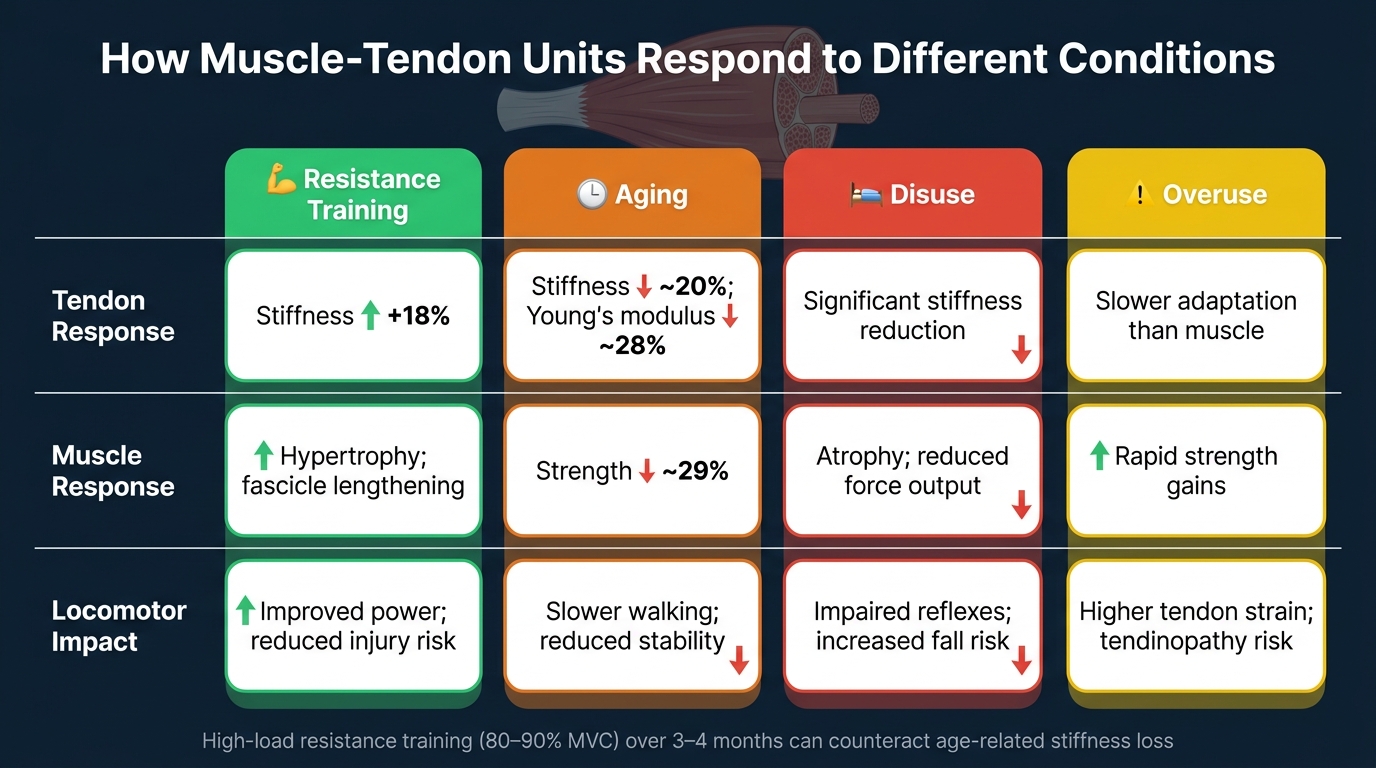
Muscle-Tendon Unit: How It Responds to Training, Aging, Disuse & Overuse
Muscle Changes with Training
When you engage in resistance training, your muscles undergo structural changes designed to enhance movement efficiency. This process, known as hypertrophy, increases muscle volume and cross-sectional area. At the same time, fascicles (the bundles of muscle fibers) lengthen, which expands the muscle's range of motion and improves its ability to generate force across various movement speeds. These adaptations are tailored to the specific demands of an athlete's activity. For instance, a sprinter's muscles develop differently from those of a distance runner, reflecting the unique requirements of their sport. These muscular improvements also pave the way for complementary changes in tendon properties.
How Your Muscles Change With Exercise
Tendon Adaptation to Mechanical Loading
Tendons, like muscles, adjust to regular mechanical stress by remodeling themselves. This involves both increasing collagen production and breaking down old collagen to meet higher physical demands. A study conducted in 2018 at the Norwegian School of Sport Sciences highlighted this process. In one high-load training study, participants performed repeated isometric plantarflexions at around 80% of their maximum voluntary contraction (MVC) several times per week over multiple weeks. The results? Achilles tendon stiffness increased substantially, and plantarflexion strength improved by a similar order of magnitude. Additionally, during single-leg drop landings, trained participants experienced a 27% reduction in gastrocnemius fascicle lengthening, showing how a stiffer tendon can better protect muscle fibers from strain.
As Werkhausen explained:
"Tendons also act as mechanical buffers to accommodate rapid stretches of the muscle–tendon unit (MTU), enabling safe energy dissipation via eccentric muscle contraction."
Interestingly, tendons and aponeuroses (the connective tissue layers attached to tendons) also show temporary changes during exercise. Short bouts of repeated contractions can temporarily increase tendon and aponeurosis compliance, altering how force is transmitted through the MTU during exercise. However, while training can lead to these benefits, factors like aging, disuse, and overuse can create challenges for the MTU.
Effects of Aging, Overuse, and Disuse on Muscle-Tendon Units
Aging naturally reduces both muscle strength and tendon stiffness. Research led by Christopher McCrum found that aging leads to marked declines in strength in the triceps surae and quadriceps, alongside substantial decreases in tendon stiffness. This reduction is primarily tied to a reduction in the tendon’s Young’s modulus, indicating that the tendon's material becomes less stiff rather than simply shrinking. For older adults, lower Achilles tendon stiffness is linked to slower performance on mobility tests like the "up and go" and the 6-minute walk.
Inactivity, even for short periods, has a similar effect. For example, even relatively short periods of unloading or inactivity can measurably reduce tendon stiffness. This increased compliance may affect muscle spindle sensitivity, making it harder to detect small joint movements and raising the risk of falls. On the other hand, overuse poses a different challenge. Muscles often gain strength faster than tendons can adapt, creating a mismatch that increases mechanical strain on tendons. This imbalance can lead to conditions like tendinopathy. As Kiros Karamanidis and Gaspar Epro put it:
"Muscle strength improvements with insufficient compensatory adaptations in tendon mechanical properties would potentially increase the mechanical demand for the tendon (i.e., higher strain)."
The good news? Tendons can respond to loading at any age. High-load resistance training at 80–90% of MVC, sustained over 3–4 months, can counteract age‑related losses in tendon stiffness and contribute to more efficient movement mechanics.
The table below provides a quick comparison of how muscle-tendon units respond under different conditions:
| Condition | Tendon Response | Muscle Response | Locomotor Impact |
|---|---|---|---|
| Resistance Training | Increased stiffness (+18%) | Hypertrophy; fascicle lengthening | Improved power; reduced injury risk |
| Aging | Stiffness ↓ ~20%; Young's modulus ↓ ~28% | Strength ↓ ~29% | Slower walking; reduced stability |
| Disuse | Significant stiffness reduction | Atrophy; reduced force output | Impaired reflexes; increased fall risk |
| Overuse | Slower adaptation than muscle | Rapid strength gains | Higher tendon strain; tendinopathy risk |
Conclusion: Key Takeaways on Muscle-Tendon Interaction in Locomotion
Muscles and tendons work together as a highly efficient system. Tendons play a crucial role by storing elastic energy and releasing it during push-off, contributing a substantial fraction of the total mechanical work, depending on task and speed. This "elastic assist" allows muscle fibers to produce force more efficiently, leading to measurable improvements in energy use.
A prime example of this system's efficiency is the unique structure of the human Achilles tendon. For instance, the Achilles tendon in humans constitutes a much larger portion of the plantar flexor muscle–tendon unit than in chimpanzees. As Anthony J. Blazevich from the Centre for Human Performance explains:
"The long Achilles tendon may therefore be a singular adaptation that provided numerous physiological, biomechanical, and psychological benefits and thus influenced behaviour across multiple tasks."
The adaptability of this system is a cornerstone of its performance. When tendon strain reaches 2–3% during maximum isometric force production, metabolic power consumption drops to its lowest levels. This efficiency translates to a net ankle mechanical efficiency of about 64% during stance, compared to just 25% for muscle-positive work alone. These findings highlight how understanding anatomy can directly impact strategies for improving athletic performance and rehabilitation.
Interestingly, the balance between tendon stiffness and muscle fascicle length changes depending on the activity. Walking benefits from more compliant tendons and shorter fascicles, while running is better supported by stiffer tendons and longer fascicles. Thomas J. Roberts sums it up well:
"The mechanical abilities of muscle–tendon units as integrated actuators far exceed the capabilities of muscle contractile elements alone."
Grasping the details of this interaction is more than academic - it has real-world applications. Whether you're developing a training regimen, recovering from an injury, or aiming to move more efficiently, understanding the MTU system is invaluable. This knowledge underscores the importance of anatomy education in unlocking the secrets of locomotor biomechanics.
FAQs
How do tendons make running feel easier than it should?
Tendons play a key role in making running feel less strenuous by acting as natural springs. When your feet strike the ground, tendons stretch to absorb energy, and then they recoil, helping to propel your body forward. This process reduces the workload on your muscles, enabling them to function more effectively at slower speeds and within smaller ranges of motion. By cutting down on muscle fatigue, tendons help lower the energy your body needs, making running feel less taxing overall.
What does tendon stiffness change in walking vs. sprinting?
During walking, the Achilles tendon shows more flexible mechanics, allowing for smoother and more energy-efficient movement. On the other hand, sprinting demands stiffer tendon behavior, which helps optimize power transfer and improve performance at higher speeds.
Can you safely improve tendon stiffness without getting injured?
Yes, you can improve tendon stiffness safely with resistance training. Studies reveal that tendons respond positively to mechanical loading, which can boost movement efficiency and lower the chance of injuries. Regular training, particularly over a period of 12 weeks with higher-intensity loads, has been shown to be effective. These changes help your body handle the physical demands of both everyday life and athletic activities. The Institute of Human Anatomy provides helpful resources to deepen your understanding of tendon function and how they adapt to exercise.

